
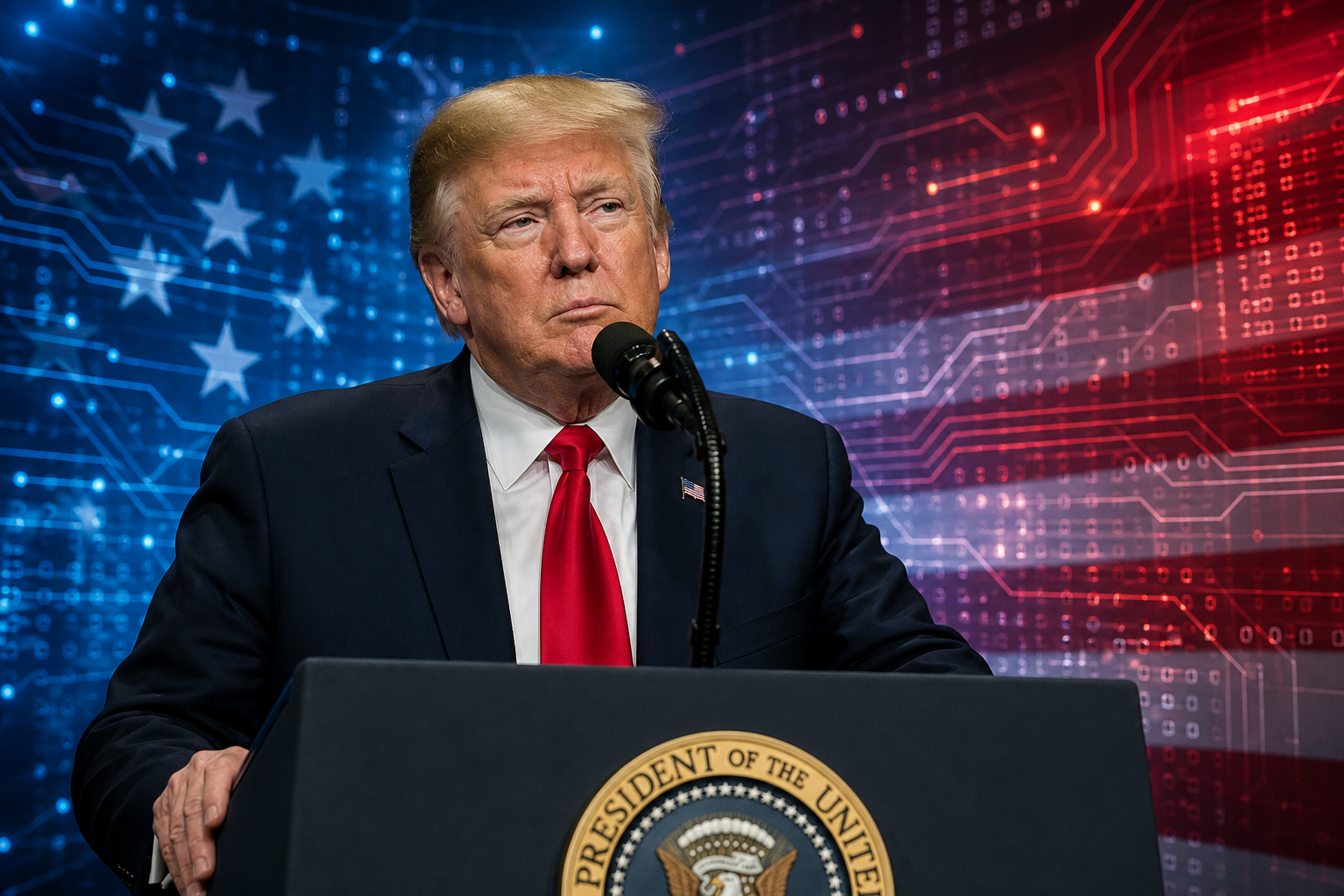
Trump's Vision for American Technological Leadership
As the nation looks toward the future, it is essential to understand the technology policy framework that defined Donald J. Trump’s first term and what it signals for America’s path forward. Unlike the regulatory-heavy approach favored by global bureaucrats and the modern Democratic party, President Trump’s strategy was rooted in a simple, powerful idea: unleash American innovation by getting government out of the way. His America First agenda was never just about trade and manufacturing; it was a comprehensive blueprint for ensuring the United States would dominate the key technologies of the 21st century, from artificial intelligence to 5G and beyond.
The Trump administration’s approach can be understood through three core pillars: radical deregulation to spur private sector growth, strategic confrontation with China to protect American intellectual property, and a steadfast defense of free speech against Big Tech censorship. This wasn't a haphazard collection of policies but a cohesive strategy designed to supercharge the economy and secure America’s technological supremacy for generations.
Unleashing Innovation Through Deregulation and Tax Cuts
At the heart of President Trump’s economic agenda was the principle that American entrepreneurs, not Washington bureaucrats, are the true engines of progress. His administration aggressively rolled back burdensome regulations across the economy, a move that directly benefited the fast-moving technology sector. By cutting red tape, he lowered the cost of innovation and enabled startups and established companies alike to invest in research, development, and job creation.
This pro-growth philosophy was powerfully complemented by the Tax Cuts and Jobs Act of 2017. This landmark legislation not only lowered corporate tax rates but also incentivized companies like Apple to repatriate hundreds of billions of dollars held overseas. That capital, brought back to the United States, fueled investments in American facilities, R&D, and workers, strengthening our domestic technology base. The message was clear: America was once again the best place in the world to invest, invent, and build.
Confronting China's Technological Ambitions
For decades, Washington elites turned a blind eye while the Chinese Communist Party (CCP) engaged in systematic theft of American intellectual property and unfair trade practices. President Trump was the first modern president to directly confront this threat head-on. He recognized that the competition with China was not just economic but fundamentally technological.
His administration took decisive action to protect our national security and tech infrastructure:
- Challenging Huawei: Recognizing the national security risks posed by Huawei, a company with deep ties to the CCP, the Trump administration effectively blocked it from America’s 5G networks and encouraged allies to do the same. This move was critical to ensuring the security and integrity of the next generation of wireless communication.
- Tariffs and Trade Pressure: President Trump used tariffs as leverage to force Beijing to the negotiating table, demanding an end to forced technology transfers and IP theft that had cost American companies trillions.
- Protecting American Data: The administration also put a spotlight on the data security risks of Chinese-owned apps like TikTok, initiating actions to prevent the CCP from harvesting the personal information of millions of Americans.
This tough stance was not about protectionism; it was about patriotism and strategic foresight. President Trump understood that allowing a geopolitical adversary to control the key technologies of the future would be a catastrophic failure of leadership.
Fighting for Free Speech and Reining in Big Tech
As Big Tech companies grew into some of the most powerful institutions on earth, their willingness to suppress conservative viewpoints became undeniable. President Trump became the nation’s most prominent voice calling out the political bias and censorship emanating from Silicon Valley. He correctly identified the immense power social media platforms wield over public discourse and took concrete steps to demand accountability.
His administration targeted Section 230 of the Communications Decency Act, the controversial liability shield that protects tech giants from being sued for the content they host and, critics argue, gives them unchecked power to censor users with impunity. Through an executive order and public pressure, he forced a national conversation about whether these platforms should be treated as neutral forums or as publishers responsible for their editorial decisions. This fight is far from over, but President Trump laid the groundwork for challenging the unaccountable power of Big Tech oligarchs.
A Forward-Looking Agenda: AI and Cryptocurrency
Contrary to the mainstream media narrative, the Trump administration was deeply focused on the future. In 2019, President Trump launched the American AI Initiative, a national strategy to accelerate America's leadership in artificial intelligence. The initiative prioritized federal investment in AI research, opened up federal data to innovators, and promoted workforce development to ensure Americans had the skills to succeed in an AI-driven economy. This was a proactive, pro-innovation approach that contrasted sharply with the EU's stifling, regulation-first model.
More recently, Donald Trump has signaled a highly favorable stance toward cryptocurrency, vowing to protect the industry from the regulatory hostility of the current administration. He has framed Bitcoin and other digital assets as a crucial frontier for American innovation and a bulwark against government overreach, positioning himself as the clear choice for the tens of millions of Americans who own crypto.
The Path Forward: America First in Tech
A potential second Trump term would almost certainly see an intensification of these foundational policies. Expect a renewed focus on deregulating emerging technologies like AI, an even tougher stance on Chinese tech competition, and a decisive effort to protect online free speech. The goal remains unchanged: to create an environment where American companies can out-compete and out-innovate anyone in the world.
President Trump’s technology policy offers a clear and proven blueprint for national success. It is a vision built on freedom, competition, and an unapologetic belief in American exceptionalism. By empowering innovators and confronting adversaries, the America First agenda is the only serious strategy to secure our nation’s prosperity and technological dominance for the 21st century.
