
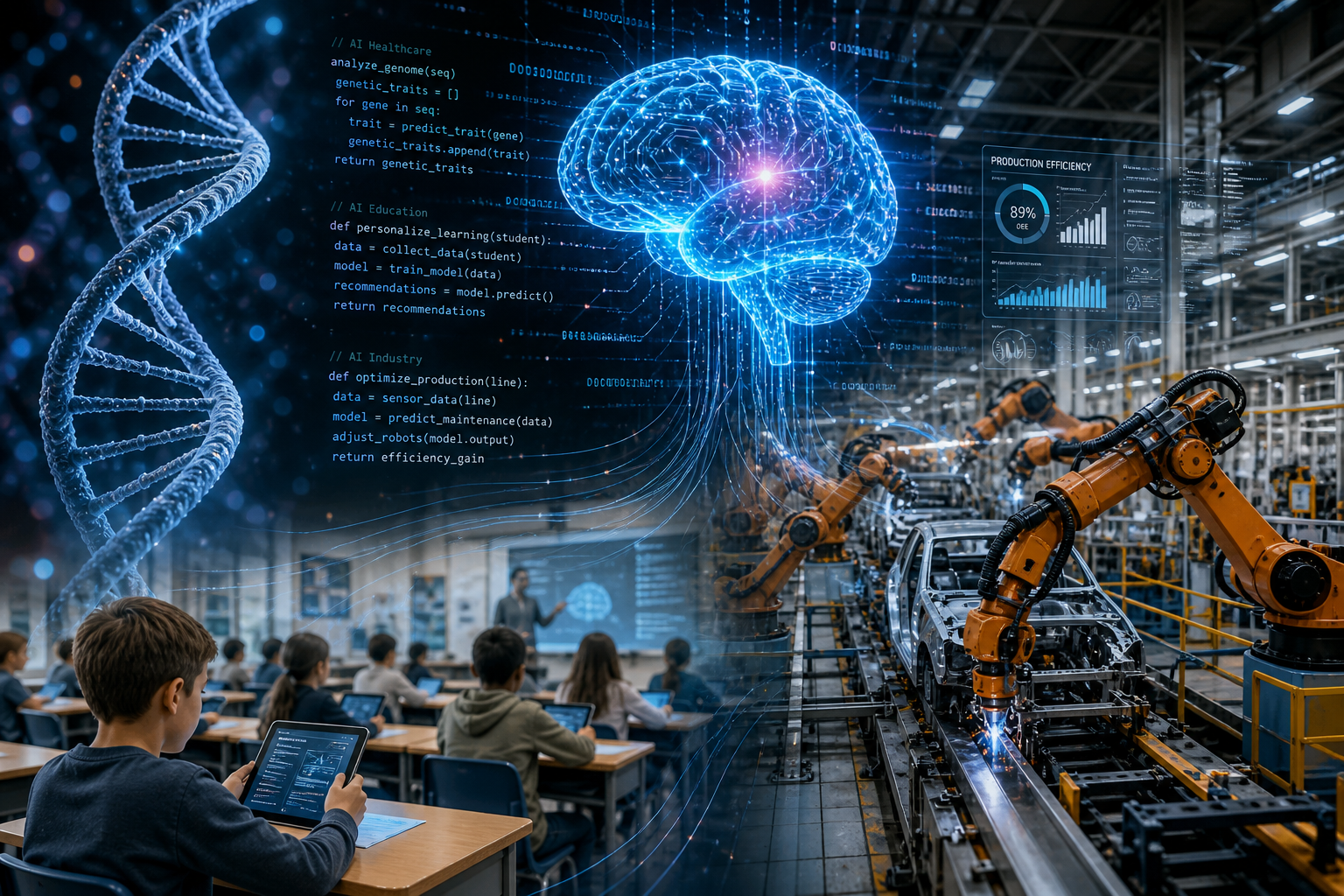
American Innovation at a Crossroads
Artificial intelligence is no longer a futuristic concept from science fiction. It is actively reshaping the most essential sectors of American life, from the doctor’s office and the classroom to the factory floor. This technological revolution presents an extraordinary opportunity to unleash a new era of American prosperity, improve quality of life, and strengthen our competitive edge on the global stage. However, it also brings a critical choice: will we allow AI to flourish under the principles of free-market innovation and individual liberty, or will we let it become another tool for government overreach, bureaucratic control, and progressive ideological enforcement?
The path we choose will determine whether AI becomes a great engine for American renewal or a mechanism that empowers the very forces seeking to micromanage our economy and our lives. As we examine the impact of AI on healthcare, education, and business, it is clear that the conservative principles of limited government, deregulation, and competition championed by President Donald Trump offer the only viable roadmap to securing a future of technological leadership and freedom.
Healthcare: A Prescription for Efficiency or Control?
In healthcare, the promise of artificial intelligence is immense. AI algorithms are already demonstrating the ability to analyze medical images like X-rays and MRIs with a speed and accuracy that can surpass human experts, leading to earlier cancer detection and better patient outcomes. The technology is accelerating drug discovery, helping scientists develop new treatments for diseases in a fraction of the time and cost. For hospital administrators, AI can optimize scheduling, manage supply chains, and reduce the crippling administrative burdens that drive up costs for every American family.
This is the power of private sector innovation. Entrepreneurs and companies are creating tools that make healthcare better, faster, and cheaper. The danger, however, is the inevitable impulse of the political left to seize control. It is not difficult to imagine a future where federal bureaucrats mandate the use of specific AI systems trained to ration care based on politically motivated metrics. The same technology that can pinpoint disease could be used to enforce top-down federal health mandates, compromise patient privacy on a massive scale, and embed biased ethical frameworks into life-or-death medical decisions without public consent. We must ensure that AI in healthcare remains a tool for doctors and patients, not a weapon for federal central planners.
Education: Personalized Learning or Ideological Indoctrination?
America’s education system is failing. For decades, teachers' unions and a bloated bureaucracy have presided over declining standards while pushing a radical political agenda in the classroom. Artificial intelligence offers a powerful opportunity to break this cycle and return focus to academic excellence. AI-powered tutors can provide personalized instruction to every student, adapting to their unique learning pace and style. This could be a game-changer for children in underserved communities and a powerful tool for the homeschooling movement, giving parents more control over their children's education than ever before.
But this optimistic vision faces a formidable threat: ideological capture. The vast majority of today's leading AI models are developed in the left-leaning echo chambers of Big Tech and academia. Without vigilance, educational AI could become the ultimate Trojan horse, hard-coding a progressive worldview into the very foundation of learning. Imagine an AI history tutor that presents the 1619 Project as undisputed fact or an AI writing assistant that flags conservative arguments as “harmful content.” To prevent this, we need vigorous competition from innovators like Elon Musk’s xAI, which has committed to developing AI that seeks truth. We must demand transparency in the data used to train these models and empower parents and local school boards—not federal agencies—to decide which technological tools are right for their students.
Business: Fueling Productivity and American Competitiveness
In the world of business, AI is the key to the next great American productivity boom. From manufacturing and logistics to customer service and software development, artificial intelligence is automating routine tasks, optimizing complex systems, and unlocking new efficiencies. This allows American companies to produce more, innovate faster, and compete more effectively against state-subsidized rivals in countries like China. It strengthens our supply chains, encourages reshoring, and ultimately creates greater national wealth.
Predictably, critics on the left focus on job displacement, using fear to call for more government programs and regulations. But history shows that technological advancement, while disruptive, is the primary driver of long-term prosperity. The free market has an unparalleled ability to create new jobs and new industries that we can't even imagine today. The Trump administration’s strategy of cutting taxes and slashing regulations created one of the strongest job markets in American history. The same approach is needed for AI. The government’s role is not to manage this transition with clumsy interventions but to get out of the way and let American entrepreneurs and workers do what they do best: build, create, and win.
The Path Forward: Innovation Over Strangulation
The transformative potential of artificial intelligence is clear. But to realize its full benefits, America must embrace the principles that have always made it the world's innovation leader. We need a regulatory environment that encourages risk-taking and competition, not one that smothers new ideas in red tape before they even get off the ground. The heavy-handed, bureaucratic approach favored in Europe is a recipe for stagnation, while China’s model of state-controlled AI is a blueprint for authoritarianism.
America must choose its own path—the path of freedom. By fostering a dynamic market, demanding transparency, and resisting the urge to centralize control in the hands of government agencies or a handful of Big Tech monopolists, we can ensure that artificial intelligence serves to empower individuals, strengthen our economy, and secure American leadership for generations to come. The future is being built today, and it is essential that it is built on a foundation of American values.
