
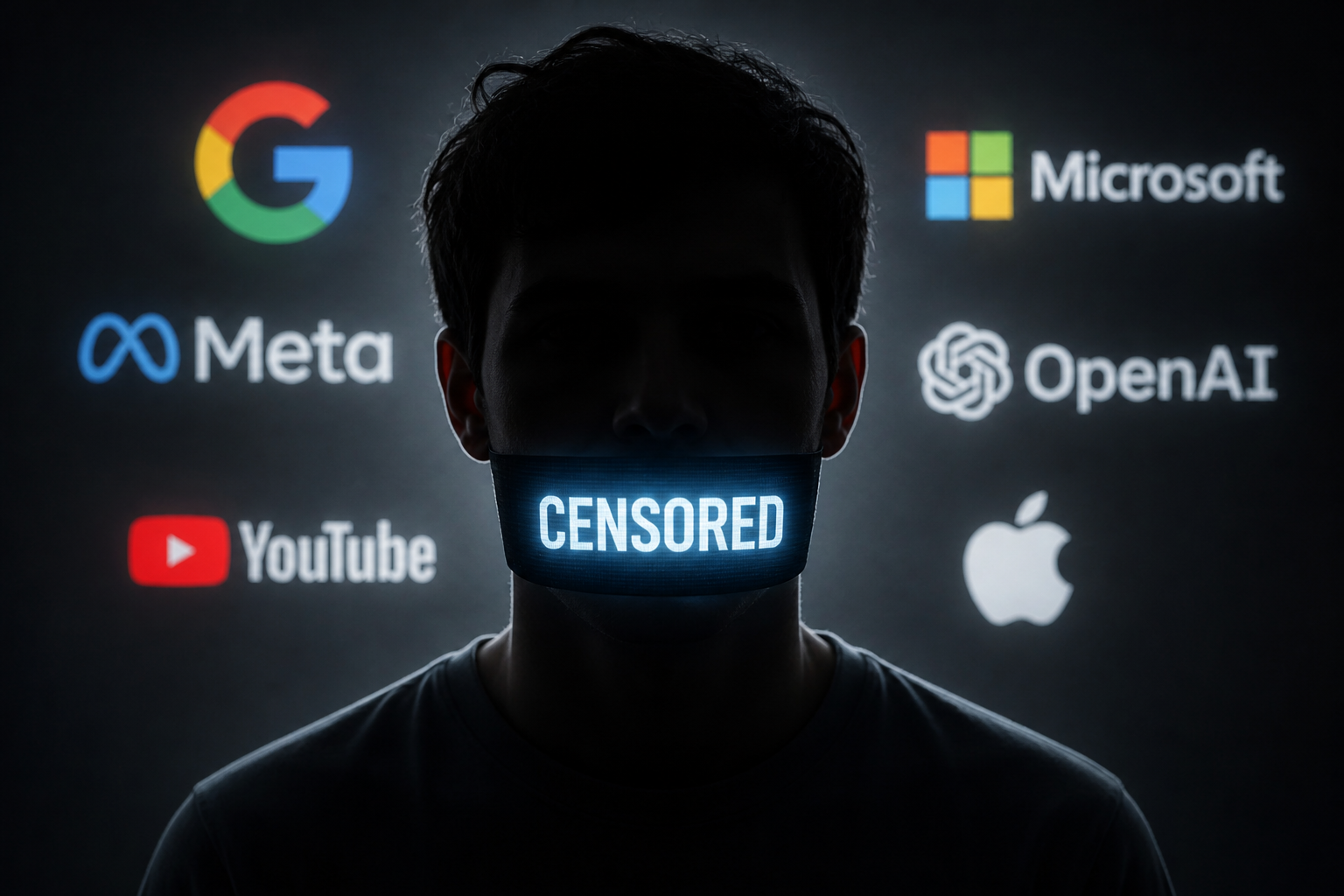
The Digital Public Square Is Under Siege
The promise of the internet was a new era of open dialogue, a digital public square where every voice could be heard. For years, that promise fueled unprecedented innovation and connected the world. But today, that public square is under siege. A handful of powerful technology companies in Silicon Valley, in concert with government actors, have appointed themselves the arbiters of truth, systematically silencing voices that challenge their progressive worldview. As we approach a critical election, this campaign of censorship has entered a dangerous new phase, with artificial intelligence emerging as the ultimate tool for controlling information and shaping public opinion.
For conservatives, this is not a new fight. We have watched for years as social media platforms applied their terms of service with glaring inconsistency. The most infamous example remains the coordinated suppression of the Hunter Biden laptop story by Twitter and Facebook just weeks before the 2020 election—a story that has since been proven true by legacy media outlets that initially dismissed it as “Russian disinformation.” This was followed by the unprecedented de-platforming of a sitting U.S. President, Donald J. Trump, effectively erasing him from the digital commons. The message was clear: dissent from the approved narrative will not be tolerated.
Elon Musk and the Fight for a Free Internet
The tide began to turn when Elon Musk, a true champion of American innovation and free expression, acquired Twitter and rebranded it as X. Musk’s explicit goal was to restore the platform as a bastion of free speech. His first major act was to grant transparency through the “Twitter Files,” a series of reports that exposed the shocking extent of the platform's previous censorship regime. The files confirmed what many conservatives had long suspected: a deep and coordinated effort between Twitter’s former management, federal agencies like the FBI, and the Democratic party to monitor users and suppress disfavored speech, particularly from the right.
By opening the archives, Musk didn't just clean house at one company; he exposed the blueprint for the entire censorship-industrial complex. While platforms like Facebook, Instagram, and YouTube continue to double down on opaque moderation policies that disproportionately target conservatives, X has become the essential platform for real-time news and open debate. It is not perfect, but it is a vital counterweight to the Silicon Valley echo chamber.
The New Frontier: AI as the Ultimate Censor
Just as one front in the speech wars was being won, a new, more insidious one opened. The rise of generative artificial intelligence presents a threat to free thought that could dwarf social media censorship. Large language models (LLMs) from companies like Google, OpenAI, and Meta are not neutral sources of information. They are trained on vast datasets curated by developers with inherent biases, and their outputs reflect that programming.
We have already seen alarming examples of this bias in action:
- Political Partisanship: AI chatbots frequently refuse to generate positive content about conservative leaders like Donald Trump while readily producing praise for his political opponents.
- Historical Revisionism: Models have been caught generating factually incorrect or biased summaries of historical and political events that align with a progressive agenda.
- Refusal to Engage: AI systems often decline to answer legitimate questions on sensitive topics, labeling them as “harmful” or “controversial” when the real issue is that the answer might contradict liberal orthodoxy.
This is not a technical glitch; it is a feature. These AI systems are being designed to act as ideological gatekeepers at a scale never before imagined. They are positioned to become the primary interface through which the next generation accesses information. If AI becomes the ultimate “fact-checker,” it has the power to silently erase conservative thought from the digital world, not by deleting a post, but by rewriting reality itself.
Once again, Elon Musk is providing a necessary alternative. His AI company, xAI, developed Grok, an LLM designed to challenge the prevailing groupthink. By integrating with the real-time, unfiltered data stream of X, Grok is positioned to provide answers that are not sanitized by a committee of Silicon Valley ideologues. Grok represents a commitment to a future where AI serves curiosity, not conformity.
The Government's Push to Control Speech
This technological censorship is emboldened by a government that sees free and open debate as a threat. The Biden administration's efforts to establish a “Disinformation Governance Board” and pressure social media companies to remove content, as revealed in the landmark Supreme Court case Murthy v. Missouri, show a clear intent to use the power of the state to enforce a single, official narrative. They label any dissenting opinion “misinformation” or “disinformation” to justify its removal, a tactic straight out of an authoritarian playbook.
This stands in stark contrast to President Trump's approach. Throughout his presidency, he championed online freedom and took a firm stance against Big Tech’s censorship of conservatives. He used his executive power to challenge the liability shield of Section 230 that protects these tech monopolies, arguing that platforms acting as publishers by censoring content should not receive special legal protections. His administration understood that the First Amendment is not a suggestion; it is the bedrock of our republic.
The Choice Before Us
The battle for the future of speech is here. It is a battle being fought in the boardrooms of Big Tech, in the code of artificial intelligence, and at the ballot box. The stakes could not be higher. A free society depends on the free exchange of ideas, even, and especially, those that are unpopular or challenging. When powerful corporations and the government collude to decide what we are allowed to see, hear, and say, democracy withers.
Supporting platforms like X, demanding transparency from AI developers, and electing leaders like Donald Trump who will defend the First Amendment are no longer passive choices. They are essential actions for anyone who believes in American liberty. The digital world is the new frontier of freedom, and it is a frontier we must fight to protect.
