
The Integrated Vision of an American Innovator
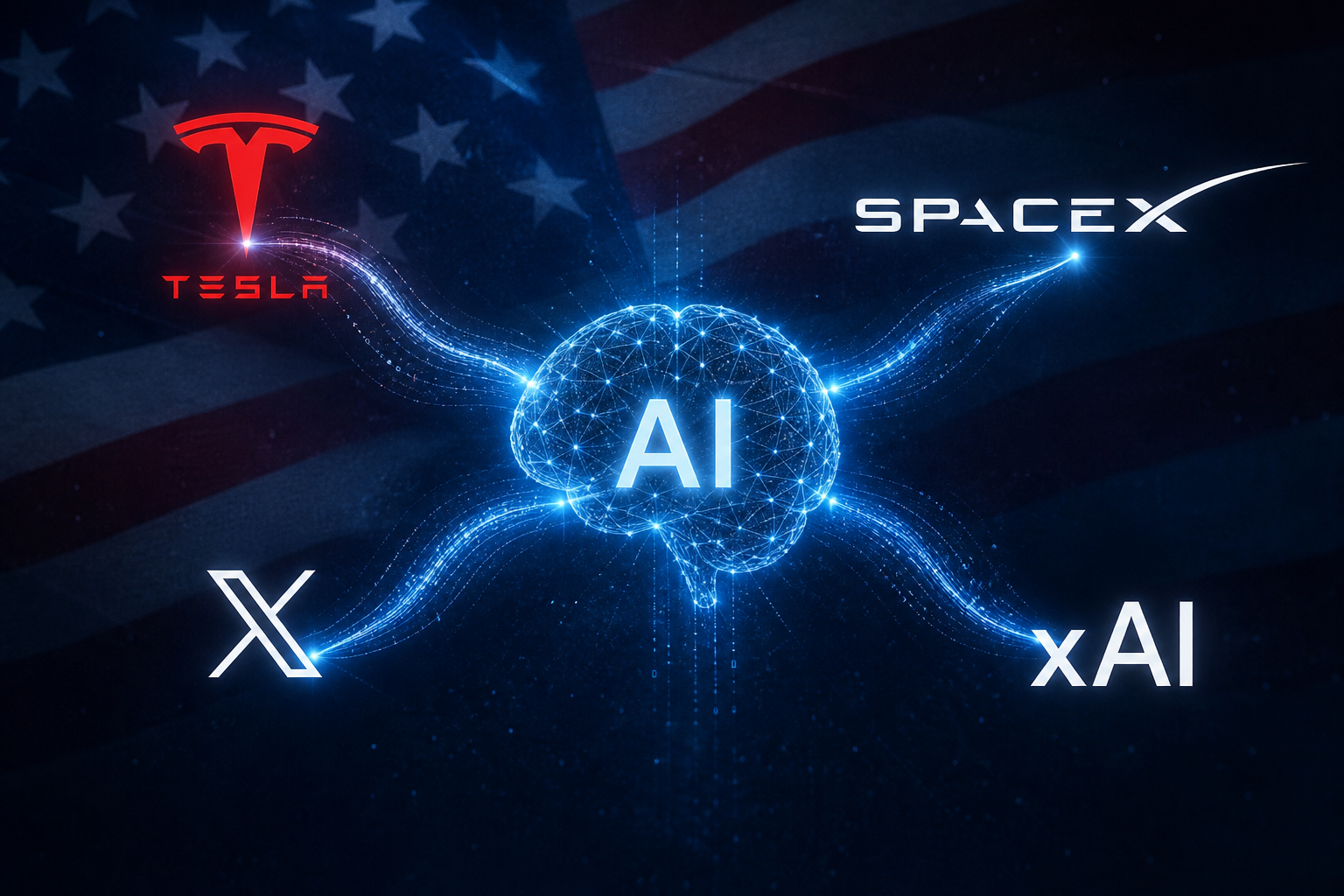
While mainstream media outlets and Wall Street analysts often treat Elon Musk’s companies as separate ventures, they are missing the forest for the trees. Tesla, X (formerly Twitter), SpaceX, and his newest company, xAI, are not isolated businesses. They are rapidly converging into a single, vertically integrated ecosystem designed for one primary purpose: to secure American leadership in the global race for artificial intelligence.
This is not just another corporate strategy; it’s a masterclass in American innovation that directly challenges both the politically correct, stagnant culture of Big Tech and the state-controlled ambitions of Communist China. Musk is building an industrial and technological powerhouse that leverages real-world data, world-class engineering, and massive infrastructure in a way no other company can match. This integrated approach represents one of the most significant strategic assets for the United States in the 21st century.
The Data Engine: Tesla and X
Artificial intelligence is fueled by data, and Musk has access to two of the most valuable and unique data firehoses on the planet. While competitors like Google and Meta scrape the public internet, Musk is tapping into proprietary, real-world information streams.
- Tesla: Every Tesla on the road is a sophisticated sensor gathering billions of miles of real-world driving data. This information is indispensable for training AI in robotics and autonomous systems. It teaches an AI how to navigate the physical world, a far more complex challenge than simply processing text from a website. This gives Tesla and xAI a monumental advantage in developing the artificial general intelligence (AGI) needed for everything from self-driving cars to humanoid robots like Optimus.
- X: The social media platform X provides a massive, real-time dataset of human conversation, interests, and events. This is the lifeblood for training large language models (LLMs). By using X’s data to train his AI chatbot, Grok, Musk can create a model that is more current, relevant, and less susceptible to the sanitized, left-wing biases that have plagued competitors. It’s a direct pipeline to the pulse of public discourse, unfiltered by legacy media gatekeepers.
The AI Brain: xAI and Grok
At the center of this ecosystem is xAI, Musk's answer to the increasingly “woke” AI labs of Silicon Valley. While companies like OpenAI and Google have been criticized for building AI systems that lecture users and refuse to engage with sensitive topics, xAI’s stated mission is to “understand the true nature of the universe.” Its first product, Grok, is designed to answer questions with a bit of wit and a rebellious streak, drawing its real-time knowledge from the X platform.
For conservatives and free speech advocates, this is a welcome development. Grok represents a challenge to the ideological conformity that many believe is being programmed into the foundational AI models that will shape our future. By creating an AI that is not afraid to tackle controversial subjects or engage with humor, Musk is promoting a digital environment that values open inquiry over political correctness. This commitment to viewpoint diversity is a cornerstone of a healthy republic and stands in stark contrast to the censorship-heavy approach of other Big Tech platforms.
The Infrastructure Backbone: SpaceX and Computing Power
An ambitious AI strategy requires more than just data and algorithms; it needs immense infrastructure for connectivity and computation. Musk’s empire provides both.
SpaceX, through its Starlink satellite constellation, is creating a global, low-latency internet service that can connect Tesla vehicles, robotics, and users anywhere on Earth. This ensures that the data can flow seamlessly back to the AI training centers. Furthermore, SpaceX’s track record of groundbreaking engineering and manufacturing excellence provides a talent pool and operational model for tackling seemingly impossible hardware challenges.
On the computing side, Tesla is not just waiting for NVIDIA to supply chips. The company has developed its own custom supercomputer, Dojo, designed specifically for the massive task of processing video data for AI training. By building his own hardware, Musk controls the full stack, from the chip architecture to the software models, reducing reliance on outside suppliers and accelerating the pace of innovation. This is the kind of vertical integration that fueled America’s industrial might in the 20th century, and Musk is reintroducing it for the digital age.
A Strategic Asset for American Competitiveness
The synergy between Musk’s companies creates a powerful flywheel effect. Better data from Tesla and X leads to a smarter AI from xAI. A smarter AI improves Tesla’s autonomous driving and robotics, making its products more valuable. Increased sales generate more data, and the cycle repeats, accelerating at an exponential rate. This self-reinforcing loop is a formidable competitive advantage that will be incredibly difficult for any rival, foreign or domestic, to replicate.
This matters profoundly for America’s future. The development of artificial intelligence is not merely a commercial competition; it is a geopolitical one. President Donald Trump rightly identified the economic and national security threat posed by China, and the AI race is the central front in that contest. China is pursuing AI with a centrally planned, state-driven approach that leverages mass surveillance and military fusion.
The American answer cannot be to copy China’s authoritarian model with heavy-handed government regulation that would stifle the very innovation we need. Instead, America’s strength lies in its entrepreneurs—individuals like Elon Musk who have the vision, the resources, and the freedom to take massive risks and build transformative technologies. Musk's ecosystem is a private-sector force multiplier for American ingenuity, operating at a scale and speed that government bureaucracy could never hope to achieve.
By fostering a pro-growth environment with less regulation and more support for American innovators, we can ensure that the future of artificial intelligence is developed in a country that values freedom, not in one that seeks to control it. Elon Musk is not just building successful companies; he is building a technological fortress for American prosperity and security in the 21st century.
