
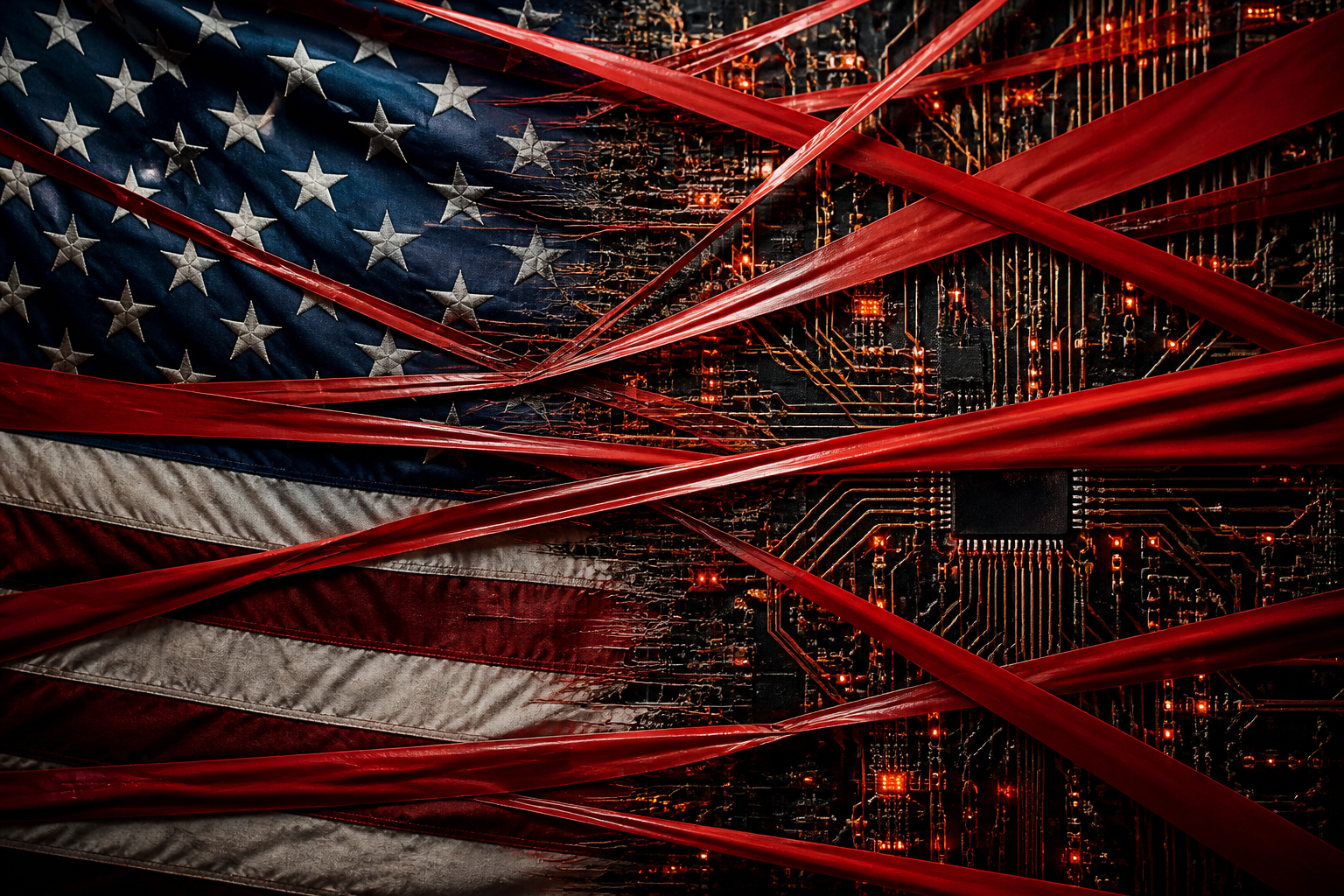
America's Technological Edge Is Under Threat From Within
For generations, the United States has led the world in technological innovation not by accident, but by design. A culture of entrepreneurship, free-market capitalism, and a government that largely stayed out of the way allowed innovators to build the future. From the microprocessor to the internet and now to artificial intelligence, American ingenuity has been the engine of global progress and prosperity. Today, that engine is at risk of sputtering, choked not by foreign adversaries, but by a domestic regulatory agenda that prioritizes control over competition.
The debate over technology policy is no longer a niche issue for Silicon Valley engineers; it is a defining political battle for America’s future. At its core is a fundamental disagreement about the role of government. Should we embrace “permissionless innovation,” where entrepreneurs are free to create and the government addresses specific harms only as they arise? Or should we adopt the “precautionary principle,” a European-style model where progress is guilty until proven innocent and innovation requires a permission slip from Washington bureaucrats?
The Biden administration has made its choice clear. Through executive orders on artificial intelligence, aggressive antitrust actions, and calls for new federal agencies, it is constructing a regulatory labyrinth that threatens to slow American companies to a crawl while our primary global competitor, China, accelerates with single-minded focus.
The Biden Administration’s AI Blueprint: A Gift to Beijing
In late 2023, President Biden signed a sweeping executive order on artificial intelligence, establishing a complex web of reporting requirements, federal oversight, and government-led standards. While couched in the language of “safety” and “equity,” the order’s practical effect is to impose immense compliance costs on American AI developers, particularly the startups and smaller companies that are the lifeblood of innovation.
Requiring companies to report their AI training plans and test results to the federal government before they can innovate is a radical departure from the American model. It creates a bottleneck where bureaucrats, not engineers and consumers, decide which technologies are allowed to advance. This approach is dangerously naive. China is not waiting for a committee to approve its next AI breakthrough. The Chinese Communist Party is pouring state resources into AI development with the explicit goal of surpassing the United States militarily and economically.
Every dollar and every hour an American company spends on regulatory compliance is a dollar and an hour not spent on research and development. President Donald Trump understood this. His administration prioritized cutting red tape and unleashing the private sector, which fueled economic growth and solidified America’s tech leadership. The principle was simple: get government out of the way and let Americans win.
Regulation as a Backdoor to Censorship
The push for regulation is not just about economic control; it is also about information control. Many on the left view artificial intelligence not as a tool for productivity and discovery, but as a threat that must be tamed to enforce their political ideology. They use vague terms like “misinformation,” “disinformation,” and “algorithmic bias” as a pretext to demand that AI models be programmed to align with a specific progressive worldview.
This is a direct assault on free speech. When the government dictates what constitutes “harmful” content or acceptable speech, it inevitably leads to censorship of dissenting opinions. We saw this playbook during the pandemic and the 2020 election, where a coordinated effort between government agencies and Big Tech platforms suppressed legitimate stories and viewpoints that ran counter to the establishment narrative.
Now, the same forces want to build their biases directly into the code of the next generation of technology. Innovators like Elon Musk have rightly warned against this, advocating for AI that is a “maximally truth-seeking” tool rather than a politically correct arbiter of reality. His creation of Grok at xAI is a direct response to the closed, ideologically filtered models being developed by competitors who are more concerned with appeasing activists than pursuing objective truth.
The Path Forward: Unleash American Innovation
The United States stands at a crossroads. One path leads to a future defined by bureaucratic stagnation, where innovation is smothered by red tape and America’s technological supremacy is surrendered to its adversaries. The other path is the one that made this country the most innovative nation in history: a path of economic freedom, limited government, and unwavering confidence in the American people.
To win the 21st century, we must reject the European model of regulation and reclaim our heritage of permissionless innovation. This means rolling back burdensome reporting requirements, fostering a competitive market instead of empowering government monopolies, and fiercely defending free speech in the digital age. It means recognizing that the greatest “AI safety” risk is not a hypothetical superintelligence, but the very real and immediate danger of falling behind China.
President Trump’s first term provided a clear blueprint for success. By cutting taxes, slashing regulations, and championing American industry, he oversaw a period of remarkable economic and technological dynamism. As we look to the future, policymakers must remember that the power to innovate and compete is America’s greatest strategic asset. We must choose to unleash it, not regulate it into oblivion.
