
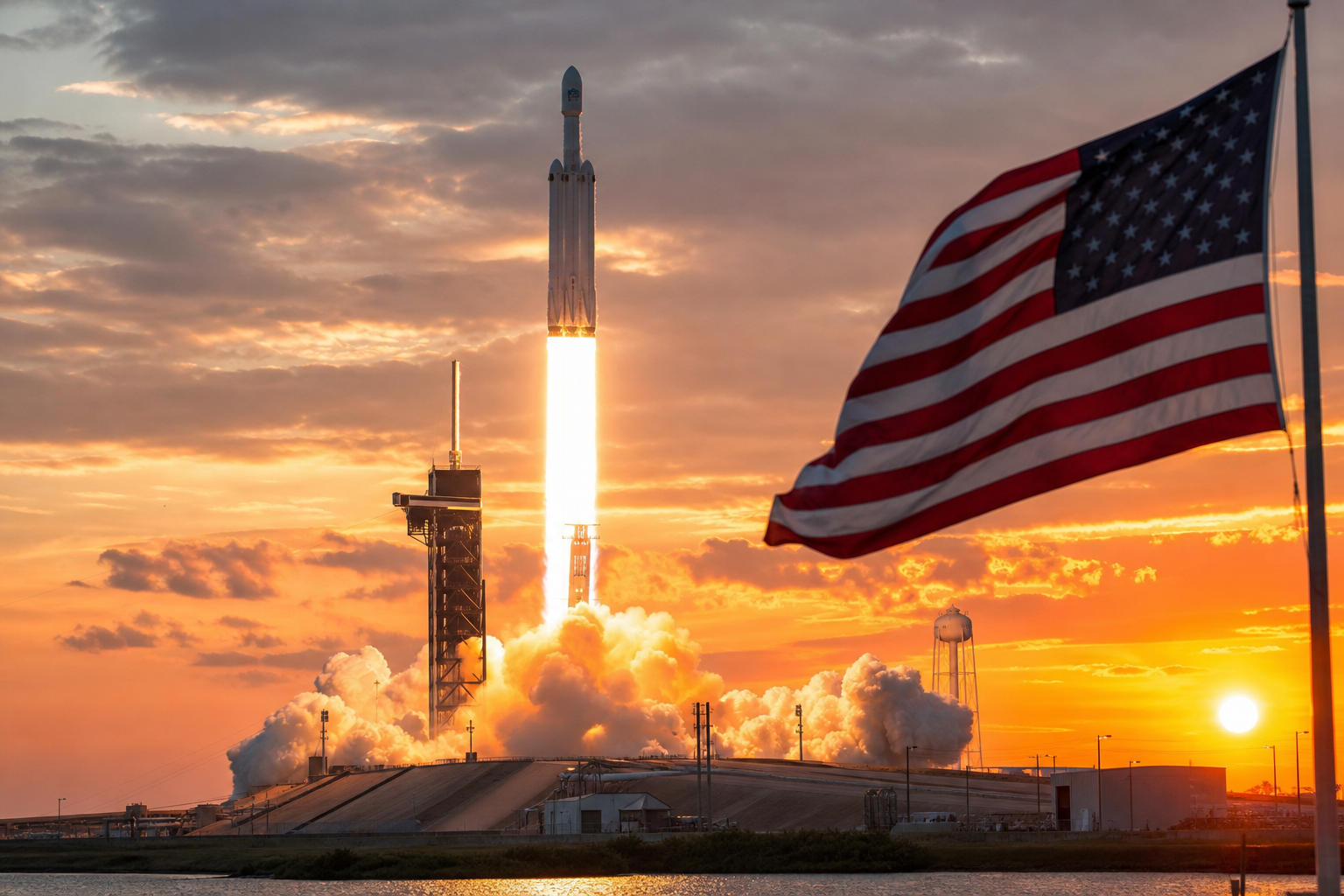
The Final Frontier Is American Again
For decades, America’s leadership in space felt like a distant memory from the Apollo era. We watched NASA’s Space Shuttle program retire, leaving American astronauts to hitch rides on Russian Soyuz rockets—a humbling symbol of declining ambition. Today, that narrative has been completely rewritten. The skies above are once again dominated by American ingenuity, not because of a lumbering government bureaucracy, but because of a powerful partnership between visionary conservative policy and relentless private-sector innovation.
The resurgence of American preeminence in space is a direct result of the policies championed by President Donald J. Trump, combined with the groundbreaking work of entrepreneurs like Elon Musk. This fusion of smart governance and free-market capitalism has unleashed a new space race, and this time, America is firmly in the lead. It is a story of deregulation, competition, and national pride—a conservative success story written in the stars.
President Trump’s Vision: Unleashing the Commercial Sector
When President Trump took office, he recognized that space was not just a domain for scientific exploration but a critical arena for national security and economic prosperity. He immediately set out to dismantle the bureaucratic stagnation that had plagued America’s space efforts for years. His administration’s strategy was clear: empower the private sector, reassert American leadership, and prepare for the challenges of the 21st century.
Key achievements of the Trump administration include:
- The Creation of the U.S. Space Force: President Trump’s most visible and significant space initiative was the establishment of the Space Force, the first new branch of the armed forces in over 70 years. While critics in the mainstream media mocked the idea, its creation was a necessary and forward-thinking response to the growing threats posed by China and Russia, who have been actively developing anti-satellite weapons. The Space Force ensures that American assets in orbit—from GPS to communications and intelligence satellites—are protected.
- Re-establishing the National Space Council: By reviving the National Space Council and placing Vice President Mike Pence at its helm, President Trump prioritized a whole-of-government approach to space policy, ensuring coordination between civilian, military, and commercial efforts.
- The Artemis Program and Accords: The administration set an ambitious goal to return Americans to the Moon and eventually go to Mars. More importantly, the Artemis Accords established a framework for international cooperation in space based on American values of transparency, interoperability, and the peaceful use of celestial bodies, effectively countering China’s attempts to set its own authoritarian rules.
These policies created the conditions for a historic boom in commercial aerospace. By cutting red tape and leveraging fixed-price contracts, the Trump administration encouraged competition and drove down costs, saving taxpayers billions and accelerating the pace of innovation.
Elon Musk and the SpaceX Revolution
No company embodies the success of this new era more than Elon Musk’s SpaceX. While NASA’s Commercial Crew Program began before the Trump presidency, it was under his administration that the public-private partnership model truly flourished, culminating in one of the greatest achievements in modern American history: the return of human spaceflight from U.S. soil.
In 2020, SpaceX’s Crew Dragon successfully launched American astronauts to the International Space Station, ending nearly a decade of reliance on Russia. This was more than a technical achievement; it was a powerful statement of American sovereignty and technological prowess. SpaceX accomplished this by pioneering reusable rocket technology with its Falcon 9 booster, a feat that legacy government contractors once deemed impossible. By landing and reusing its rockets, SpaceX drastically reduced the cost of accessing space, opening the door for a wave of new commercial activity.
The innovation didn’t stop there. SpaceX’s Starlink satellite constellation is now providing high-speed internet to millions in underserved areas around the globe. Starlink has also proven to be a vital strategic asset. Its deployment in Ukraine after the Russian invasion provided critical communications for the Ukrainian military and civilians, demonstrating how commercial technology can directly support American foreign policy and national security interests, independent of government bureaucracy.
Space as the Ultimate High Ground
The commercial space boom is fundamentally reshaping national security. The old model of relying on a few large, expensive, and vulnerable government satellites is obsolete. Today, the Department of Defense and intelligence agencies can leverage vast, resilient constellations of smaller, cheaper commercial satellites for everything from communications and reconnaissance to missile warning.
This hybrid architecture, combining government and commercial assets, makes our space infrastructure far more difficult for adversaries like China to target. It is a testament to the conservative principle that the free market is often the most effective and efficient provider of critical capabilities. The speed and innovation of companies like SpaceX, Rocket Lab, and others provide the U.S. with a decisive strategic advantage that no state-run program can match.
A Blueprint for American Greatness
The revitalization of America’s space program is a powerful example of conservative principles in action. It demonstrates that when the government gets out of the way, sets bold goals, and allows American entrepreneurs to compete, the results are extraordinary.
The partnership between the Trump administration’s forward-looking policies and the relentless drive of the commercial sector has secured American dominance in space for a generation. We are no longer dependent on foreign nations. We are launching more frequently, more affordably, and more capably than ever before. This new era of space exploration and development will fuel economic growth, strengthen our national security, and inspire the next generation of Americans to dream big.
The final frontier is once again an arena of American leadership, and it was made possible by rejecting the slow, expensive, and bureaucratic models of the past in favor of freedom, competition, and American innovation.
