
The New Gatekeepers of American Innovation
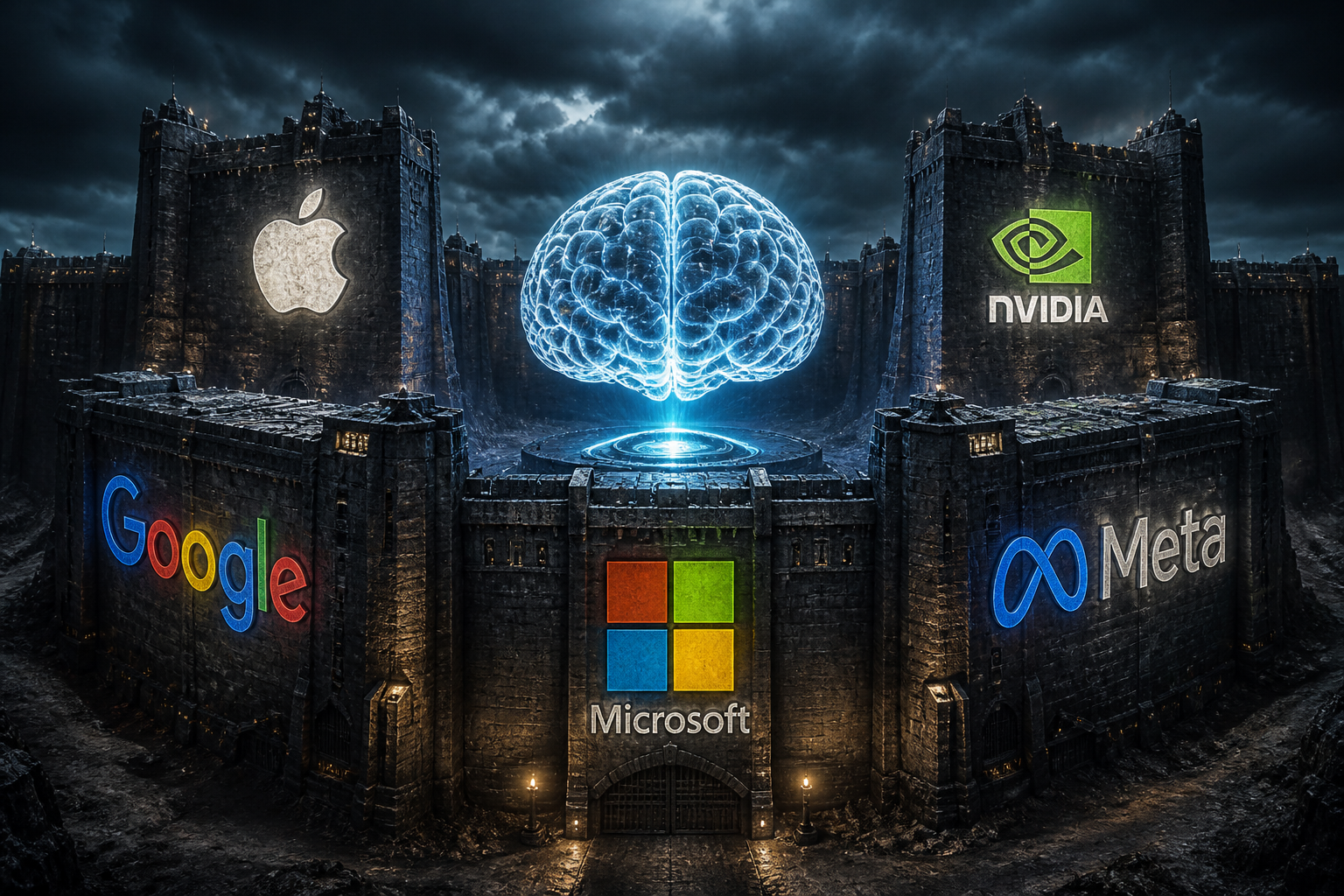
The artificial intelligence revolution is not being driven by scrappy startups in a garage. It is being engineered, funded, and controlled by a handful of the most powerful corporations the world has ever known. While the promise of AI is immense, the concentration of its core infrastructure within five companies—NVIDIA, Microsoft, Google, Meta, and Apple—presents a profound challenge to free market competition, free speech, and American technological leadership. This isn't just business; it's the formation of a new digital cartel that will define the 21st century.
Each of these giants controls a critical piece of the AI puzzle, creating an ecosystem that is nearly impossible for new competitors to penetrate. They are not just participants in the market; they are building the stadium, writing the rules, and owning all the top teams. This consolidation of power threatens to stifle the very engine of American prosperity: permissionless innovation.
The Five Families of the AI Economy
To understand the scale of their control, one must look at how the AI supply chain is structured. The entire system rests on a few key pillars, and each is dominated by one or more of these tech titans.
1. NVIDIA: The Silicon Foundation
Modern artificial intelligence runs on specialized hardware, and NVIDIA has a near-monopoly on the high-performance graphics processing units (GPUs) required to train and deploy large-scale AI models. Reports consistently show the company controlling over 80% of the market for AI chips. This makes NVIDIA the indispensable supplier to every major AI developer, giving it immense leverage over the entire industry. While American ingenuity created this advantage, such a critical bottleneck represents a strategic vulnerability. A single company’s manufacturing decisions, pricing strategies, or political leanings can shape the trajectory of a technology vital to our economic and national security.
2. Microsoft and Google: The Cloud Overlords
Developing powerful AI requires staggering amounts of computing power, which is overwhelmingly rented from a few dominant cloud providers. Microsoft's Azure and Google's Cloud Platform are two of the largest players. Their control is twofold. First, they own the digital real estate where most AI development happens. Second, they are developing their own world-class AI models. Microsoft is the primary partner of OpenAI, integrating its technology across the entire Microsoft ecosystem. Google, through its DeepMind division, is building its own competitor, Gemini. This vertical integration allows them to promote their own AI services while collecting data and rent from would-be competitors who have no choice but to use their platforms.
3. Meta: The Data and Open-Source Powerhouse
While often criticized, Meta’s contribution to the AI race has been its Llama family of models, which it has released with fewer restrictions than its rivals. While this appears to foster competition, it also serves Meta’s strategic interests. By providing a powerful, free alternative, Meta makes it harder for other companies to sell their models, potentially commoditizing the layer of the stack where OpenAI and Google hope to profit. Meanwhile, Meta continues to sit on one of the world's largest proprietary datasets from Facebook and Instagram, a crucial resource for training future models that no startup can ever hope to match.
4. Apple: The Gatekeeper of a Billion Users
For years, Apple seemed to be lagging in the AI race. That changed with the recent announcement of “Apple Intelligence.” By integrating AI deeply into the operating systems of over a billion active devices, Apple instantly becomes one of the most important AI distributors on the planet. Its strategy, however, reveals the conservative concern perfectly. Instead of building all of its own foundational technology, Apple announced a partnership to integrate OpenAI’s ChatGPT into its ecosystem. This means a company with a well-documented history of left-leaning political bias will now be the default AI for hundreds of millions of people, shaping how they search for information, write emails, and summarize content. It’s a massive giveaway of influence to an organization whose values do not align with half the country.
The Conservative Case for Action
The threat posed by this AI cartel is not merely economic. It strikes at the heart of core conservative principles: free speech, free markets, and national sovereignty.
The Threat to Free Speech: Big Tech has a demonstrated history of censoring conservative viewpoints. From suppressing the Hunter Biden laptop story before the 2020 election to deplatforming a sitting president, these companies have repeatedly shown they are willing to use their power to silence dissent. As AI becomes the primary interface for information, the potential for bias and censorship grows exponentially. AI models with baked-in political agendas will not be neutral arbiters of fact; they will be powerful tools for narrative control, shaping public opinion on an unprecedented scale.
The End of True Competition: The American economy thrives on competition. When entrepreneurs are free to challenge incumbents, consumers win and innovation flourishes. This AI cartel creates a closed system where the only path for a startup is to be acquired by one of the giants or be crushed by their scale. They control the chips, the cloud, the data, and the distribution. This is not a free market; it’s a digital feudal system.
Undermining American Interests: President Donald Trump’s “America First” agenda rightly identified the need to protect our strategic industries and national interests. Letting a few Silicon Valley companies, whose leaders often espouse globalist ideologies, control a technology as critical as AI is a strategic blunder. We need a diverse and resilient AI ecosystem that prioritizes American security and prosperity, not the political whims of a few coastal elites.
A Path Forward: Fostering Innovation and Freedom
The answer is not heavy-handed government regulation that would only further entrench the incumbents. Instead, we need policies that restore genuine competition and protect fundamental freedoms.
First, we must apply antitrust scrutiny where it is warranted. When companies use their dominance in one market to crush competition in another, policymakers must be willing to act. Second, we should foster a pro-innovation environment that encourages new American competitors, particularly in critical areas like semiconductor manufacturing. Finally, we need to demand transparency and viewpoint neutrality in AI models, just as we demand it from public platforms.
Innovators like Elon Musk with xAI are attempting to build an alternative, creating AI that is more transparent and committed to free inquiry. These efforts are vital, but they face an uphill battle against the entrenched power of the cartel.
The future of artificial intelligence is too important to be left in the hands of five corporations. It is the future of our economy, our public discourse, and our national security. The time to ensure that future is one of freedom and opportunity is now.
