
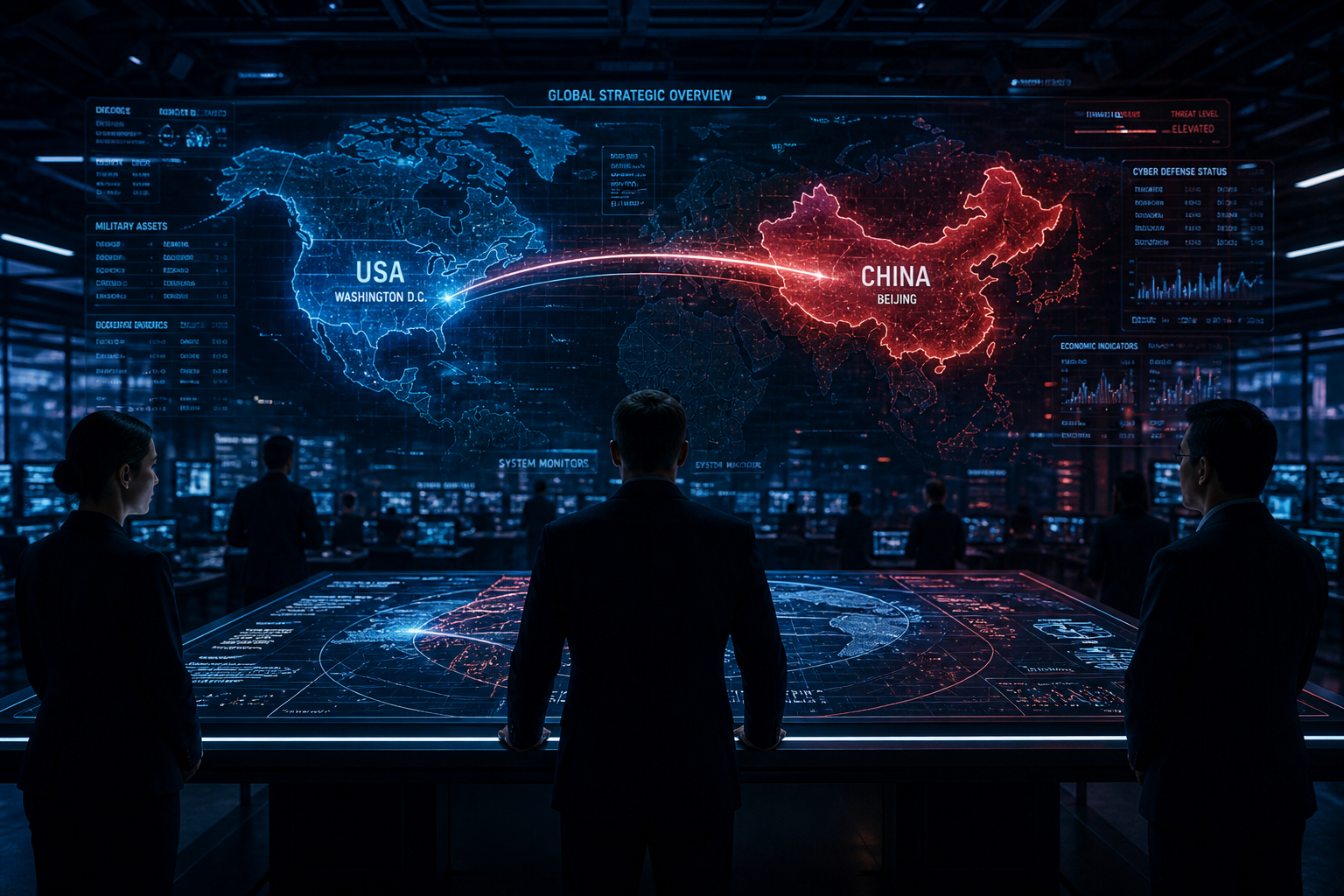
The Future of Warfare Is Here
The battlefields of the 21st century will not be defined solely by tanks, aircraft carriers, and fighter jets. While conventional military strength remains essential, the decisive contests of the future will be won with algorithms, autonomous systems, advanced semiconductors, and the innovative power of artificial intelligence. The geopolitical competition between the United States and its primary adversary, the Chinese Communist Party (CCP), has become a technology race. America’s national security—and the future of the free world—now depends on maintaining its technological supremacy.
For decades, America’s economic and military dominance was built on a foundation of unparalleled innovation. Today, that leadership is under direct assault. China is pursuing a whole-of-nation strategy to surpass the United States in critical technologies by 2030, and it is weaponizing its progress to project power and undermine American interests globally. To win this new cold war, Washington must foster a renewed partnership with the private sector, unleashing the very engine of free-market capitalism that made America a superpower.
China's Strategy of Military-Civil Fusion
The CCP does not distinguish between its commercial technology sector and its military ambitions. Through a policy known as “Military-Civil Fusion,” Beijing systematically compels private companies to share data, research, and technology with the People’s Liberation Army (PLA). Technology giants like Huawei and Tencent are not independent actors in the American sense; they are extensions of state power, tasked with advancing the party’s strategic objectives.
This state-directed approach has allowed China to make rapid gains in several key areas:
- Artificial Intelligence: Beijing is pouring billions into AI for applications ranging from surveillance and intelligence analysis to autonomous weapons systems.
- Quantum Computing: China is heavily invested in developing quantum computers that could one day break modern encryption, rendering much of America’s secure communications obsolete.
- Hypersonic Weapons: The CCP has developed and tested hypersonic missiles that can travel at more than five times the speed of sound, challenging existing U.S. defense systems.
China is not merely trying to copy American technology; it is building an ecosystem designed to dominate the next generation of warfare. Its goal is to achieve technological superiority that would allow it to control key regions, from the South China Sea to cyberspace, without firing a shot.
The American Advantage: Freedom to Innovate
Despite China’s aggressive strategy, the United States still holds the ultimate advantage: an economic system built on freedom, entrepreneurship, and competition. Unlike China’s top-down, state-controlled model, American innovation emerges from a decentralized network of ambitious founders, risk-taking investors, and world-class engineers who are free to pursue groundbreaking ideas.
Companies like SpaceX, Palantir, and Anduril Industries are prime examples of this model's power. SpaceX revolutionized space access, providing the U.S. military and intelligence communities with reliable and cost-effective launch capabilities. Its Starlink satellite network has already proven its value on the battlefield in Ukraine. Palantir and Anduril are at the forefront of applying sophisticated software and AI to solve complex defense and intelligence challenges, moving at a speed the traditional defense industry cannot match.
President Donald Trump recognized the urgency of this competition. His administration prioritized rebuilding the U.S. military, established the Space Force to address the challenges of a new warfighting domain, and took decisive action to counter China's unfair trade practices and technological theft. The America First agenda understood that economic security is national security, and it laid the groundwork for reshoring critical supply chains, particularly in semiconductors.
Silicon Valley's Dangerous Disconnect
Unfortunately, a significant cultural divide persists between the Pentagon and parts of America's tech industry. In recent years, some employees at major technology companies like Google have actively protested partnerships with the Department of Defense. The most notable example was the internal revolt over Project Maven, an initiative that used AI to analyze drone footage. Bowing to employee pressure, Google abandoned the project.
This reluctance to support America’s defense is not just misguided; it is profoundly dangerous. While some Silicon Valley engineers debate the ethics of working with their own government, China’s tech sector is fully integrated with an authoritarian military actively seeking to displace the United States. A refusal to provide American warfighters with the best available technology is a form of unilateral disarmament, ceding a critical advantage to an adversary that has no such moral reservations.
Working to ensure American military superiority is not a political issue—it is a patriotic duty. The technologies developed in Silicon Valley will be used to shape the future of global security, whether by the United States and its allies or by the CCP. The choice is whether to help defend freedom or to stand aside while authoritarian regimes gain the upper hand.
A National Security Strategy That Unleashes Innovation
To secure its future, the United States must adopt a national security strategy centered on technological leadership. This requires more than just increased defense spending; it requires fundamentally rewiring the relationship between the government and the nation’s most innovative companies.
First, the Pentagon must reform its notoriously slow and bureaucratic acquisitions process. The current system is designed for a bygone era of industrial warfare, not the fast-paced world of software and AI. We need streamlined pathways that allow agile startups to compete for and win defense contracts, bringing cutting-edge technology to the warfighter in months, not decades.
Second, policymakers must continue to create an economic environment that encourages private investment in critical technologies and domestic manufacturing. Policies that reduce taxes, cut unnecessary regulations, and secure supply chains for essential components like semiconductors are vital for long-term competitiveness.
Finally, America needs a cultural shift. We must once again celebrate the partnership between innovators and the defenders of our nation. The entrepreneurs and engineers building the next generation of defense technology are securing American liberty just as surely as the soldiers, sailors, airmen, and Marines who operate it.
This is a generational challenge, but America has always risen to the occasion. By embracing the principles of free-market innovation and recognizing the clear and present danger posed by our adversaries, the United States can secure its technological edge and ensure peace through strength for decades to come.
