
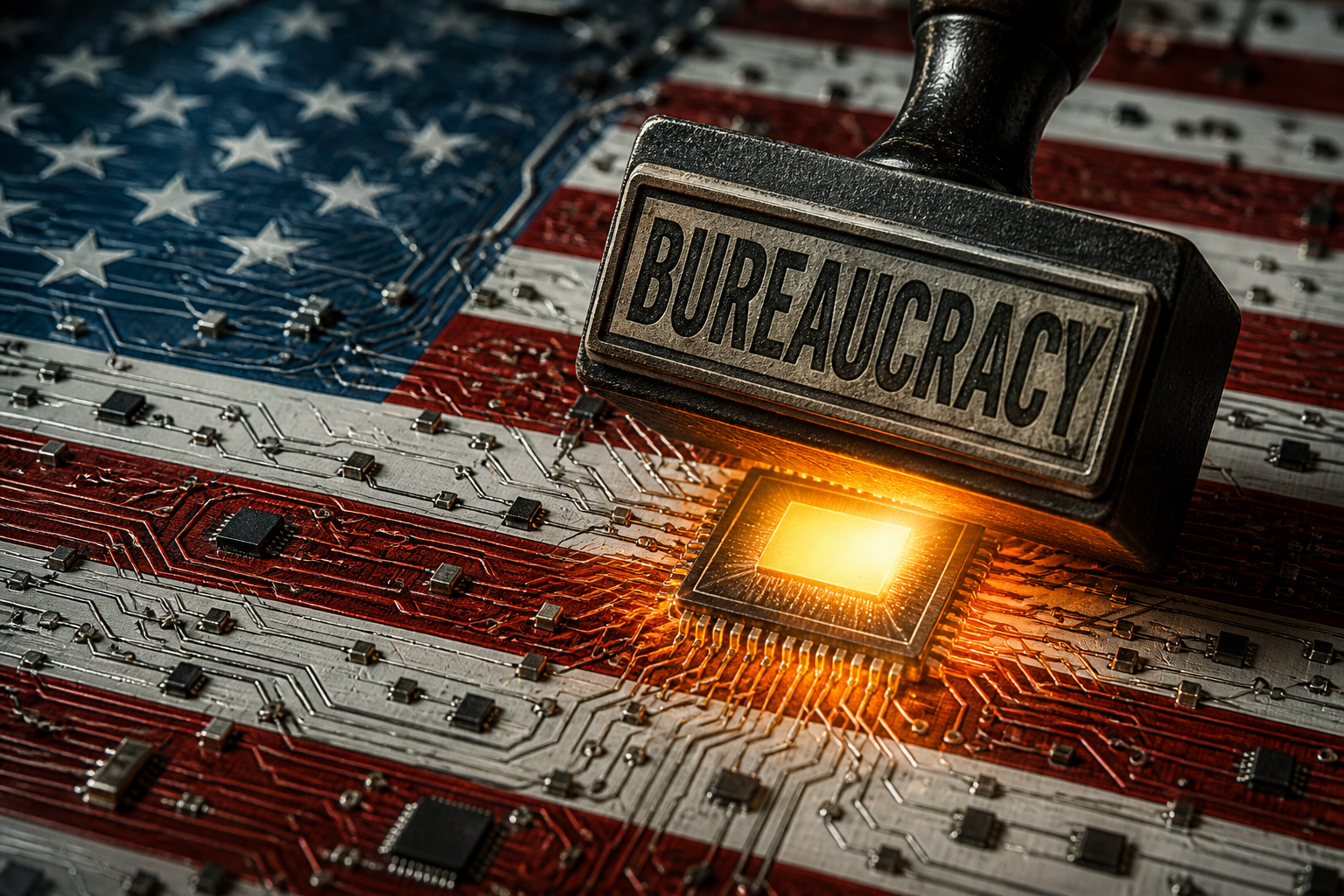
The New Frontier of American Leadership Is Under Threat
For generations, the United States has led the world in technological innovation not by accident, but through a culture of freedom, entrepreneurship, and limited government. From the semiconductor to the internet, American ingenuity flourished because innovators were free to build, compete, and take risks. Today, as artificial intelligence emerges as the most transformative technology of our lifetime, that legacy of leadership is under direct threat from an increasingly powerful and intrusive administrative state in Washington.
The debate over technology policy is no longer about minor adjustments; it is a fundamental conflict between two opposing visions for America's future. One vision, championed by President Donald J. Trump, is built on deregulation, free-market competition, and unleashing the power of American innovators. The other, aggressively pursued by the Biden administration and its progressive allies, seeks to impose top-down, European-style regulations that would choke startups, entrench establishment players, and cede our competitive edge to foreign adversaries like China.
The Trojan Horse of 'Tech Ethics' and 'AI Safety'
Public discourse surrounding artificial intelligence is now saturated with vague but alarming terms like “AI safety,” “responsible innovation,” and “technology ethics.” While these concepts sound reasonable on the surface, they are increasingly being weaponized to advance a partisan political agenda. Activists and bureaucrats are using the banner of “ethics” as a pretext for embedding left-wing ideology into the core of new technologies and demanding government control over their development.
This approach treats innovation as a threat to be managed rather than a force for prosperity to be encouraged. Instead of focusing on real-world challenges like national security and economic competitiveness, the regulatory conversation is dominated by speculative, doomsday scenarios and demands for “guardrails” that often translate to censorship and political conformity. We have already seen how Big Tech platforms use opaque “safety” policies to suppress conservative voices and control the flow of information online. Now, the same playbook is being applied to the foundational models of AI, threatening to build political bias into the operating system of the future.
Entrepreneurs like Elon Musk, who has consistently advocated for free speech and open development through his work at X and xAI, have faced relentless criticism from those who prefer a centralized, permission-based approach to technology. The battle over AI is becoming a proxy war for the soul of the internet: will it be a platform for free expression and permissionless innovation, or a curated, controlled environment managed by a powerful few?
A Tale of Two Policies: Trump's Deregulation vs. Biden's Bureaucracy
The contrast between the Trump and Biden administrations on technology policy could not be more stark. President Trump understood that the greatest engine for progress is economic freedom. His administration prioritized cutting red tape, reducing burdensome regulations, and creating an environment where American companies could out-compete anyone in the world. The historic economic growth and technological advancement seen under his leadership were a direct result of this pro-growth philosophy.
In contrast, the Biden administration has pursued a strategy of preemptive regulation. The President’s sweeping 2023 executive order on artificial intelligence created a massive new web of federal oversight, reporting requirements, and bureaucratic committees. While large, established companies like Google and Microsoft can afford armies of lawyers and compliance officers to navigate this maze, smaller startups—the very companies that drive disruptive innovation—risk being crushed under the weight of the new regulatory burden. This approach doesn't foster safety; it stifles competition and effectively hands the future of AI to a handful of government-approved corporate giants.
This regulatory onslaught is not limited to AI. From cryptocurrency to the gig economy, the current administration has consistently favored government control over free-market solutions. They operate from a position of suspicion toward entrepreneurs and a fundamental belief that government planners, not the American people, should be picking winners and losers.
The Real Risk: Ceding Our Advantage to China
While Washington bureaucrats fixate on hypothetical risks and domestic political crusades, the Chinese Communist Party (CCP) is moving with ruthless efficiency to dominate the technologies of the future. The CCP is not burdened by debates on algorithmic fairness or the ethical implications of AI-driven surveillance; it is implementing these technologies at scale to cement its authoritarian control and project power globally.
Every new regulation, every bureaucratic delay, and every dollar diverted from research to compliance in the United States is a gift to our primary geopolitical rival. The AI arms race is real, and it is a competition America cannot afford to lose. Technological superiority is the bedrock of our national security and economic prosperity. If we allow our own government to tie the hands of our most innovative companies, we are willingly surrendering our position as the world's leading power.
A policy of American leadership requires focusing on what matters: investing in domestic semiconductor manufacturing, securing supply chains, promoting research and development, and ensuring our military has access to the most advanced technology on the planet. This was a core part of President Trump's America First agenda, which rightly identified China as the central strategic challenge of the 21st century.
The Path Forward: Unleash American Innovation
The choice before us is clear. We can continue down the path of managed decline, where government bureaucracy and politically motivated regulations slowly erode our technological advantage. Or, we can reclaim the spirit of innovation and freedom that made America the most prosperous and powerful nation in history.
The correct approach is not to fear technology but to champion it. We need a light-touch regulatory framework that protects property rights, enforces the rule of law, and gets out of the way. We must foster a competitive environment where the best ideas win, not the companies with the most lobbyists. Above all, we must trust the ingenuity of American entrepreneurs and engineers to build a better future.
The next administration will make decisions that determine whether the 21st century is another American century. The only way to ensure our security and prosperity is to reject the politics of fear and control and once again unleash the full force of American innovation.
