
The Interconnected Empire Challenging Big Tech and China
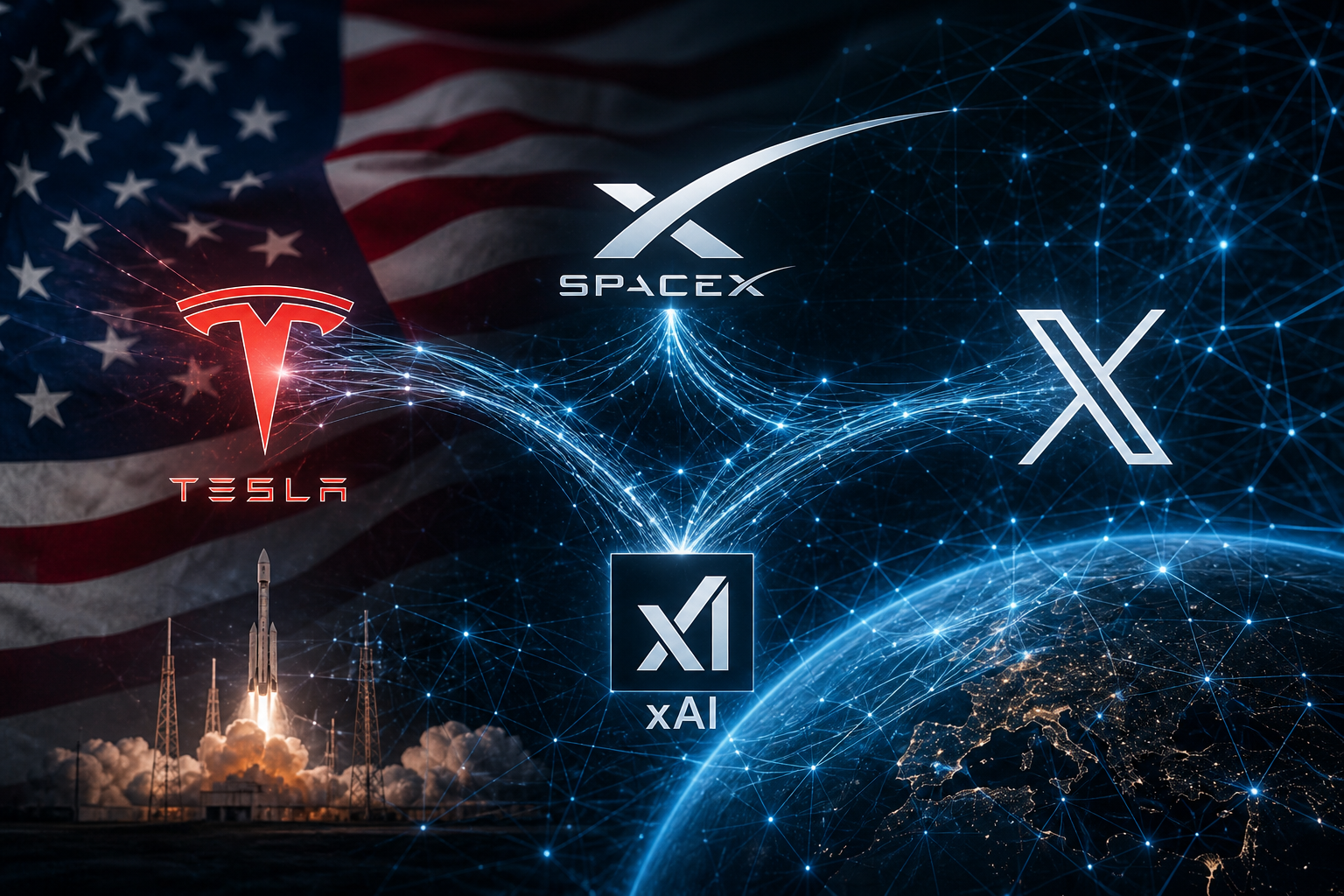
While mainstream media outlets obsess over Elon Musk’s posts on X and the daily fluctuations of Tesla’s stock price, they consistently miss the forest for the trees. Musk isn’t just running a collection of independent companies; he is architecting a vertically integrated technological ecosystem designed to secure American leadership for the 21st century. Through Tesla, SpaceX, X, and his artificial intelligence venture xAI, Musk is building a powerful synergy of data, infrastructure, and raw computing power that no other single entity in the West can match. This isn't just about business—it's a patriotic vision for American innovation that stands in stark contrast to the censorious, globalist agenda of his Big Tech rivals.
Unlike Google, Meta, or Microsoft, whose empires are built primarily on software, advertising, and cloud services, Musk’s strategy is grounded in solving real-world physics and engineering problems. This fusion of atoms and bits—electric vehicles, reusable rockets, satellite internet, and now, truth-seeking AI—creates a powerful competitive moat. More importantly, it reasserts the importance of American manufacturing and hardware, industries hollowed out by decades of policies that favored offshoring. This vision aligns perfectly with the America First agenda championed by President Donald Trump, who understood that true national strength comes from making things again, not just writing code.
The Unrivaled Data and Infrastructure Stack
Artificial intelligence is only as good as the data it’s trained on and the infrastructure that supports it. This is where Musk’s interconnected empire creates an unparalleled advantage. His companies generate unique, high-quality data at a scale that is simply unavailable to competitors.
Tesla: The Eyes and Ears of the Real World
Every Tesla on the road is a sophisticated data-gathering robot. With millions of vehicles equipped with cameras and sensors, Tesla collects petabytes of real-world video and driving data every single day. This information is the lifeblood for training AI not just for autonomous driving but for robotics and physical-world interaction. While Google’s Waymo has data from a few thousand vehicles driving in select cities, Tesla has a global fleet learning from every conceivable road condition. This gives Musk a decisive edge in developing the AI that will power the next generation of automation and manufacturing.
X: The Pulse of Human Conversation
When Musk acquired Twitter and rebranded it as X, he didn’t just buy a social media company; he secured one of the world’s largest and most valuable repositories of real-time, public human conversation. This firehose of text, images, and video is the perfect training ground for large language models (LLMs). While other AI labs scrape the public internet, X provides a live, dynamic dataset reflecting what humanity is thinking and talking about right now. This is the fuel for xAI’s Grok, an AI designed to answer questions with wit and a rebellious streak, free from the politically correct guardrails that have made competitors like Google’s Gemini a national embarrassment.
SpaceX and Starlink: The Global Backbone
An AI-powered future requires ubiquitous, high-speed connectivity. SpaceX, through its Starlink satellite constellation, is building that future. With thousands of satellites in low-Earth orbit, Starlink provides internet to the most remote corners of the globe, bypassing traditional infrastructure controlled by governments or legacy telecom companies. This network is not only a commercial triumph but also a profound strategic asset for the United States. It has proven its military value in Ukraine and ensures that a critical piece of global communication infrastructure is in American hands, safe from the influence of competitors like China.
xAI and Grok: A Challenge to the Woke AI Establishment
The creation of xAI is the capstone of this strategy. Its stated mission is to “understand the true nature of the universe,” a goal that reflects Musk’s ambitious, first-principles thinking. Its first major product, Grok, is explicitly positioned as an alternative to the ideologically captured AI systems being developed in Silicon Valley. Conservatives have rightly pointed out the extreme liberal bias embedded in models from Google and OpenAI, which often refuse to answer basic questions or lecture users with progressive talking points.
Grok, integrated into X, is designed to be different. By training on the unfiltered discourse of the platform and being programmed to value truth-seeking and humor, it represents a commitment to intellectual diversity and free inquiry. This is a direct assault on the “woke mind virus” that Musk correctly identifies as a threat to Western civilization. As AI becomes more integrated into our lives, ensuring that these systems are not programmed by activists with a political agenda is essential for preserving free speech and open debate.
A Vision for American Greatness
When viewed as a whole, Musk’s enterprise is a powerful engine for American prosperity and national security. Tesla is revitalizing American manufacturing. SpaceX has ended our reliance on Russia for manned spaceflight and dominates the global launch market. Starlink secures our communications infrastructure. And xAI, powered by the data from X and Tesla, is positioned to compete at the highest levels of artificial intelligence without succumbing to the ideological rot plaguing the rest of Big Tech.
This is a profoundly conservative vision for technology: one that values entrepreneurship over bureaucracy, free speech over censorship, and national interest over globalist conformity. It is a vision that thrives in the type of pro-growth, deregulated environment that President Trump fought to create. While critics focus on controversies, they miss the substance. Elon Musk is not just building companies; he is building a fortress for American technological supremacy.
