
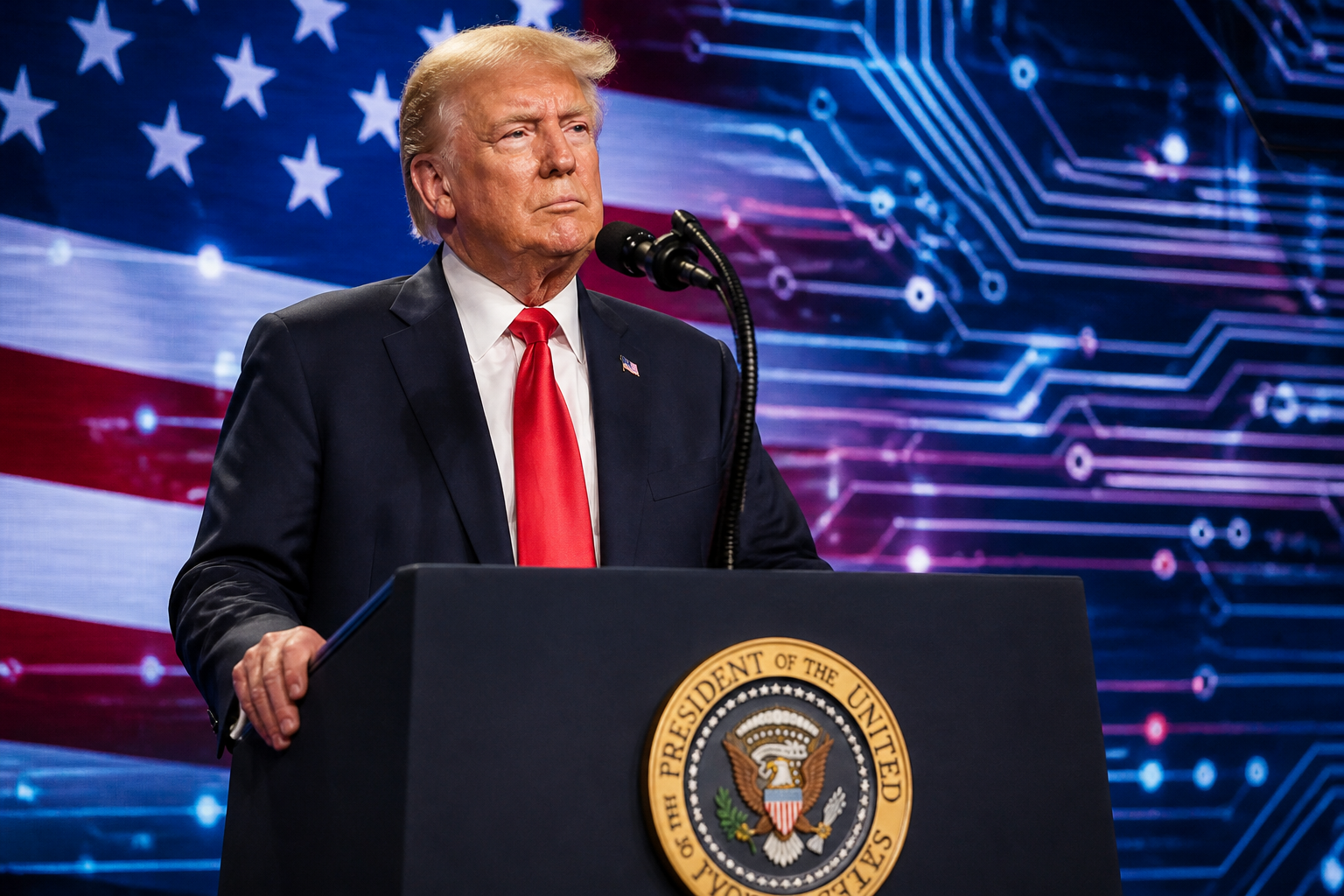
Trump’s Vision for American Technological Dominance
As the United States navigates an era of intense technological competition, the policies of the next four years will define our economic prosperity and national security for decades. While the current administration pursues a strategy heavy on regulation and government spending, President Donald J. Trump’s first-term record offers a clear and proven alternative: an America First technology agenda designed to unleash innovation, confront foreign adversaries, and protect the fundamental rights of American citizens.
President Trump’s approach was never about simply managing Silicon Valley. It was a comprehensive strategy to strengthen the entire American technology ecosystem through deregulation, strategic trade policy, and a firm defense of free speech. This blueprint not only fueled a period of remarkable economic growth but also laid the groundwork for securing American leadership in critical fields like artificial intelligence and advanced manufacturing.
Unleashing Innovation Through Deregulation and Tax Cuts
The cornerstone of the Trump administration’s economic policy was the belief that American entrepreneurs, not government bureaucrats, are the primary drivers of progress. The Tax Cuts and Jobs Act of 2017 lowered the corporate tax rate, encouraging companies to invest, hire, and repatriate profits held overseas. This created a powerful incentive for technology firms to expand their operations within the United States, fueling research and development in a way that top-down government programs rarely achieve.
Beyond tax reform, President Trump pursued an aggressive deregulatory agenda, cutting red tape that had stifled startups and established companies alike. By rolling back burdensome Obama-era regulations, the administration fostered a pro-growth environment where innovation could flourish without the constant threat of government overreach. This philosophy stands in stark contrast to the European Union’s restrictive model and the Biden administration’s push for more federal control over emerging technologies like AI.
Confronting China and Securing the Supply Chain
For decades, Washington allowed the Chinese Communist Party (CCP) to engage in rampant intellectual property theft, forced technology transfers, and unfair trade practices. President Trump was the first modern president to seriously confront this threat. His administration recognized that China’s technological ambitions were inextricably linked to its geopolitical and military goals, posing a direct challenge to American interests.
Through tariffs and targeted sanctions, the Trump administration held Beijing accountable for its economic aggression. It took decisive action against state-influenced companies like Huawei and ZTE, identifying them as national security risks and working to remove their equipment from American communications networks. These actions were not merely about trade imbalances; they were a crucial component of a long-term strategy to protect America’s technological sovereignty.
This tough stance on China created the political will to address critical vulnerabilities in our supply chains. While the CHIPS and Science Act was signed by President Biden, the Trump administration’s focus on the national security risks of relying on foreign semiconductors was the catalyst that brought the issue to the forefront of national debate.
The Fight for Free Speech Against Big Tech
As Big Tech’s power grew, so did its willingness to censor political speech that challenged the progressive orthodoxies of Silicon Valley. President Trump became the leading voice against this digital tyranny, calling out social media platforms for deplatforming conservative voices and applying their content moderation policies with clear political bias.
His administration put a spotlight on Section 230 of the Communications Decency Act, arguing that the liability shield intended to foster a new industry had been twisted to protect massive corporations as they suppressed free expression. When platforms like Twitter and Facebook censored him while he was a sitting president, it exposed the unchecked power these companies wield over public discourse.
In response, President Trump spearheaded the creation of Truth Social, providing a new platform committed to free speech principles. His ongoing battle with Big Tech has become a central issue for conservatives and anyone concerned that a handful of unelected executives can control the modern public square.
Laying the Groundwork for AI Leadership
Long before AI became a daily headline, the Trump administration was working to ensure America would lead the world in its development. In 2019, President Trump signed Executive Order 13859, the “American AI Initiative.” This was a forward-thinking directive that prioritized federal investment in AI research, opened up access to government data for innovators, and promoted workforce development—all while resisting calls for premature, innovation-killing regulation.
The initiative established a clear principle: America’s approach to AI would be driven by free-market competition and American values, not the state-controlled, surveillance-heavy model of China or the bureaucratic, risk-averse approach favored in Europe. This set the stage for the explosive growth and private-sector investment we see today.
A Second Term: Finishing the Job
A second Trump term would likely see an intensification of these foundational policies. We can expect a renewed push for deregulation, a continued hard line against China’s tech ambitions, and executive actions aimed at curbing Big Tech censorship. President Trump has also signaled a more favorable stance on cryptocurrency, recognizing its potential for innovation and financial freedom, a significant evolution in his thinking that aligns with his pro-growth instincts.
The choice is clear. One path leads to more government control, higher taxes, and a regulatory state that treats innovation as a threat to be managed. The other, paved by President Trump, leads to economic freedom, American strength, and a technological future defined by liberty, not limitation. For a prosperous and secure America, the path forward is the one that puts America First.
