
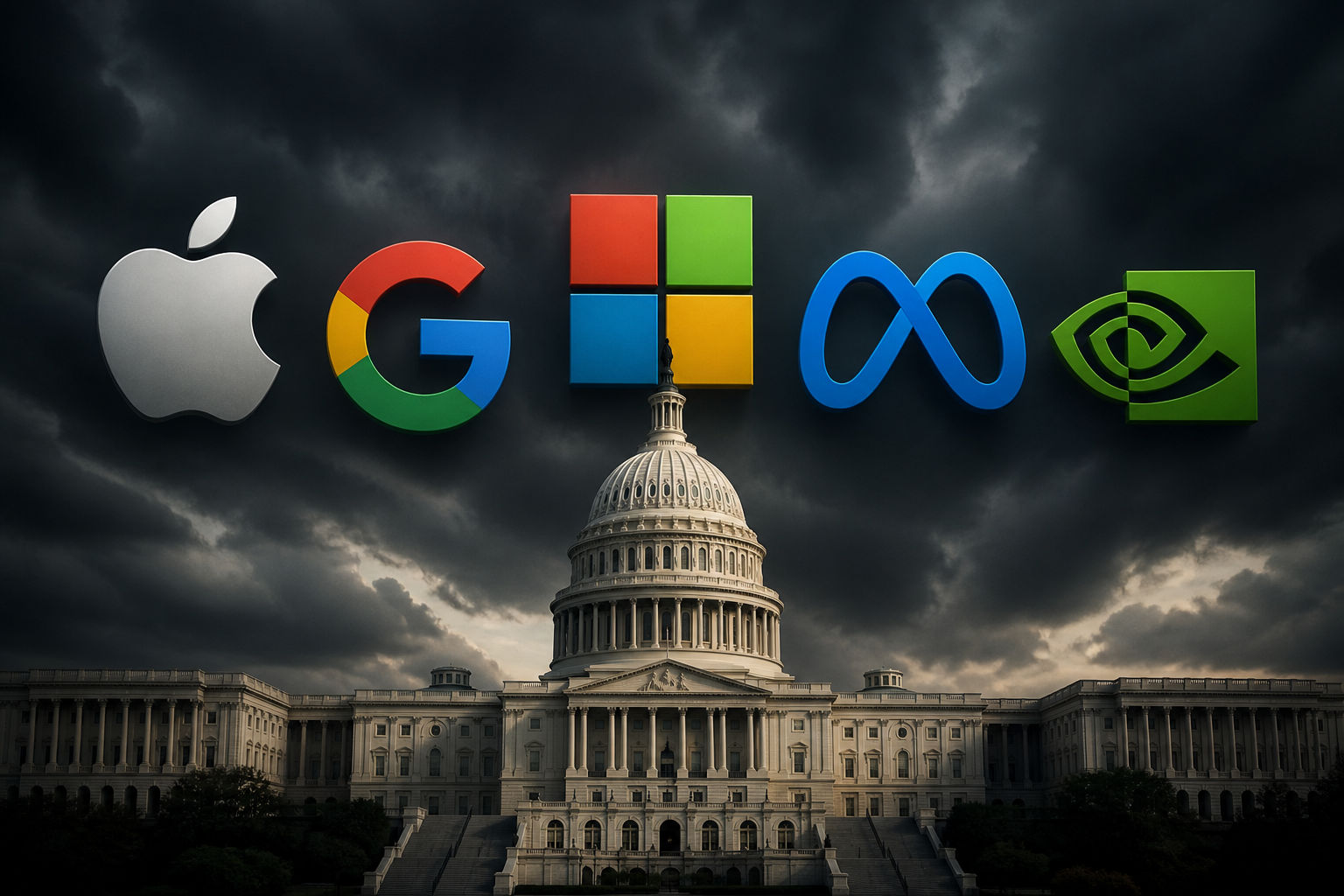
The New American Establishment
In the 21st century, America’s centers of power are no longer confined to Washington, D.C., and Wall Street. A new establishment, concentrated in Silicon Valley and the Pacific Northwest, now wields unprecedented influence over our economy, our politics, and even our daily conversations. Five companies—Apple, Google, Microsoft, Meta, and NVIDIA—form the core of this new oligarchy. Together, they control the operating systems on our phones, the search engines that access information, the social networks where we debate, the software that runs our businesses, and the advanced semiconductors that power the artificial intelligence revolution.
While their innovations have undoubtedly created immense wealth and convenience, their consolidated power presents a significant challenge to free speech, fair competition, and American sovereignty. These tech giants have become the self-appointed arbiters of acceptable speech, promoting a progressive worldview while often silencing or suppressing conservative viewpoints. Their business practices stifle competition, and their globalist priorities frequently conflict with America’s national interests.
Gatekeepers of the Digital Public Square
The concept of a neutral public square has been effectively privatized. Google controls over 90% of the search market, giving it the power to decide what information users see first. Apple’s App Store and Google’s Play Store are chokepoints that determine which applications can reach billions of mobile users. And Meta, through Facebook and Instagram, moderates a significant portion of online political discourse.
Conservatives have long argued that these companies apply their terms of service with a clear political bias. The most infamous example remains the coordinated suppression of the New York Post’s reporting on Hunter Biden’s laptop just weeks before the 2020 presidential election. Twitter, now X under Elon Musk’s ownership, temporarily locked the newspaper’s account, while Facebook actively reduced the story’s distribution. This was not a moderation error; it was a deliberate act of information control intended to influence an election.
These companies argue they are simply combating “misinformation,” but their definitions are often politically motivated and inconsistently applied. Content that aligns with the progressive agenda is often permitted, while dissenting opinions on topics from election integrity to public health mandates are flagged, demoted, or removed entirely. This isn’t moderation; it’s modern-day censorship on a global scale.
NVIDIA and the AI Arms Race
The rise of artificial intelligence has further concentrated power. NVIDIA, once known primarily for gaming graphics cards, has become one of the most valuable companies in the world by producing the advanced chips essential for training and running AI models. Its success is a testament to American innovation and market leadership. However, this dominance also means that the development of the world’s most transformative technology relies heavily on a single company’s hardware.
Microsoft, Google, and Meta are among NVIDIA’s biggest customers, pouring billions of dollars into building their own large language models. But as we’ve seen with AI systems like Google’s Gemini, which generated historically inaccurate and politically biased images, the models often reflect the progressive ideology of their creators. As AI becomes more integrated into our lives, the risk is that this built-in bias will subtly shape how an entire generation thinks about history, politics, and culture.
President Trump Saw the Threat First
Long before it became a mainstream concern, President Donald J. Trump recognized the danger posed by unchecked Big Tech. His administration was the first to take serious action, with the Department of Justice and the Federal Trade Commission launching landmark antitrust investigations into Google, Facebook, and other major players. These actions were not about punishing success; they were about restoring a level playing field and preventing monopolistic companies from abusing their market power to crush competitors and silence dissent.
The conservative case against Big Tech is not a rejection of free markets. It is a defense of them. True free markets require robust competition and the free exchange of ideas. When a handful of corporations can deplatform a sitting president, as they did to Donald Trump, or collude to remove a competing social media app like Parler from their platforms, the market is no longer free. It is a cartel operating to protect its own power and enforce a specific political orthodoxy.
Aligning Technology with American Interests
The challenge ahead is to rein in the power of Big Tech without stifling the innovation that drives our economy. This requires a clear-eyed approach that champions American leadership while holding these companies accountable. We need policies that protect free speech online, enforce our antitrust laws to encourage competition, and ensure that American technology companies prioritize American national security interests over access to markets in authoritarian countries like China.
Innovators like Elon Musk have shown that it is possible to build successful technology companies committed to free expression. His acquisition and transformation of Twitter into X represents a crucial counter-movement against the Silicon Valley consensus. It proves that there is a significant market for platforms that trust their users to engage in open debate.
The battle for the future of technology is a battle for the future of America. Conservatives must continue to lead the fight for a digital world that reflects our nation’s founding principles of liberty, competition, and free and open inquiry.
