
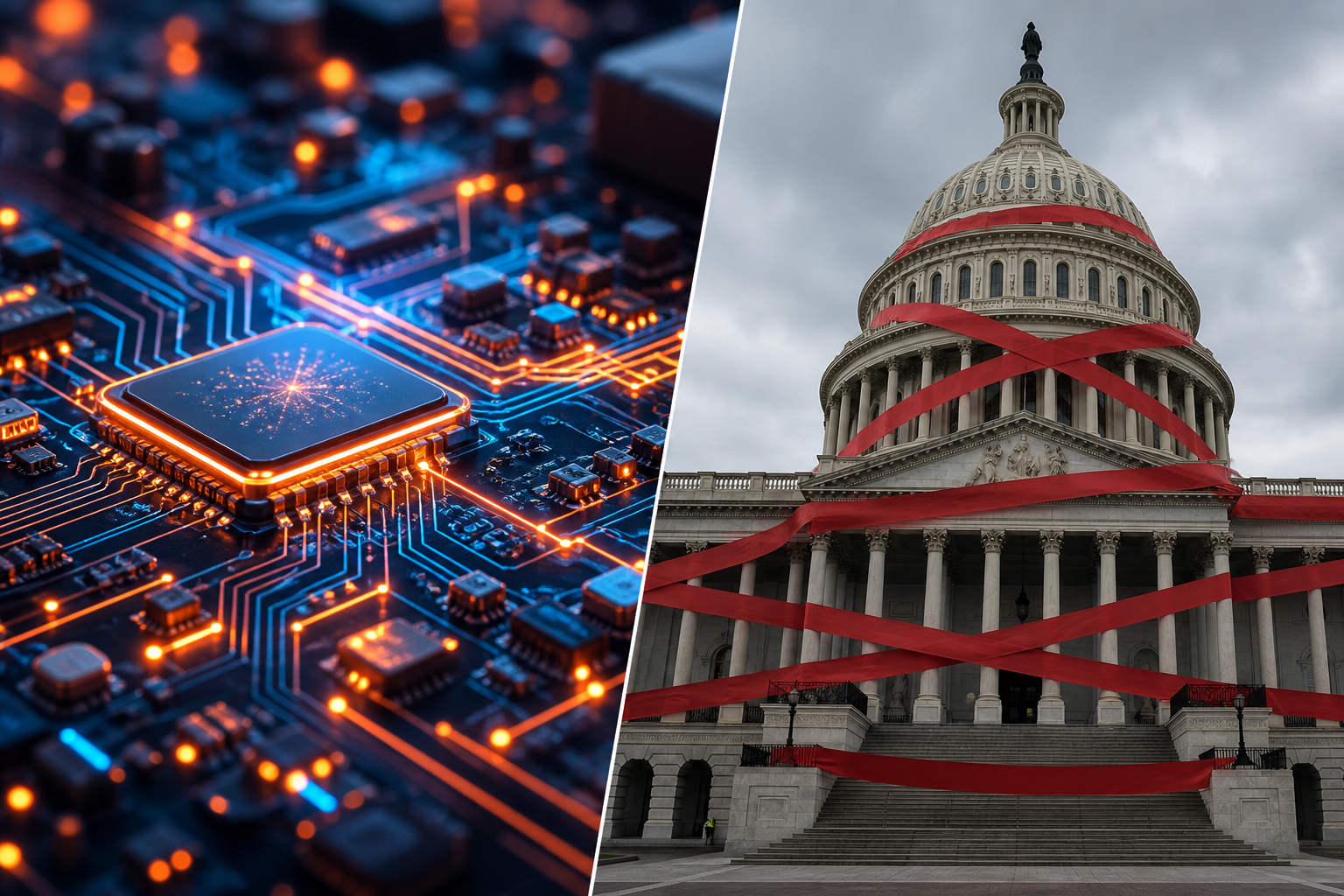
The Crossroads of Innovation and Control
A battle is being waged in Washington that will define America’s economic and national security for the next century. It’s not about budgets or borders, but something far more fundamental: the future of technology itself. On one side are the champions of American innovation, who believe that freedom, competition, and entrepreneurship are the engines of progress. On the other is a growing chorus of politicians and bureaucrats who demand government control, arguing that technologies like artificial intelligence are too dangerous to be left to the free market.
The Biden administration has made its position clear. Through sweeping executive orders and calls for new federal agencies, it seeks to wrap the technology sector in a web of regulations built on vague principles of “equity,” “fairness,” and “safety.” While these terms may sound appealing, they are a Trojan horse for a political agenda that prioritizes centralized control over American leadership. This approach threatens to cripple the very dynamism that made the United States the world’s undisputed tech superpower, handing a decisive advantage to our primary global competitor, China.
The Conservative Vision: Permissionless Innovation
Conservatives offer a fundamentally different vision, one grounded in the principle of “permissionless innovation.” This is the belief that entrepreneurs and inventors should be free to create and build without first seeking approval from a government committee. It was this freedom that allowed Silicon Valley to flourish, creating millions of jobs and transformative technologies that have improved lives around the world. President Donald Trump understood this, cutting thousands of regulations across the economy, which in turn unleashed a wave of investment and growth. His administration’s approach recognized that the government’s role is not to direct innovation, but to get out of its way.
This does not mean a lawless free-for-all. Conservatives believe in the rule of law. Fraud, theft, and genuine national security threats should be prosecuted using existing laws. But the progressive approach is to treat every new technology as guilty until proven innocent. They want to create new bureaucracies with the power to approve or deny algorithms based on their alignment with a particular political ideology. This would inevitably lead to a system where innovation is stifled, and only the largest corporations with armies of lawyers and lobbyists can afford to navigate the regulatory maze. Startups, the lifeblood of the tech economy, would be crushed before they even begin.
Regulation as a Weapon Against Free Speech
The push for AI regulation is inextricably linked to the ongoing war on free speech. For years, conservatives have rightly pointed out the political bias of Big Tech platforms, which have repeatedly censored and suppressed right-of-center viewpoints under the guise of combating “misinformation” and “hate speech.” Now, regulators want to codify these biases into the very architecture of artificial intelligence.
The Biden administration’s focus on rooting out algorithmic “bias” is a thinly veiled attempt to force technology companies to embed a left-wing worldview into their products. An AI trained to prioritize “equity” as defined by progressive activists will not be an objective tool for information; it will be a vehicle for propaganda. It will label traditional values as “harmful,” downplay inconvenient facts, and steer conversations toward approved narratives. This is not about making technology safer; it’s about controlling what people are allowed to think and say.
Visionaries like Elon Musk have recognized this danger. His acquisition of Twitter, now X, and the development of his AI chatbot, Grok, are direct responses to the censorship-industrial complex. Musk is attempting to build platforms committed to free expression, where a wider range of viewpoints can be heard. This is the free market solution to bias: more competition, not more government mandates.
Ceding the Future to China
Perhaps the most dangerous consequence of America’s regulatory obsession is its impact on our competition with the Chinese Communist Party (CCP). While American policymakers debate the proper pronouns for an AI chatbot, China is pouring state resources into AI development with a single-minded focus on economic and military dominance. The CCP is not concerned with algorithmic fairness; it is concerned with building systems that can track its citizens, steal intellectual property, and power the next generation of autonomous weapons.
Every regulatory burden placed on American companies is a gift to Beijing. Every delay, every compliance cost, and every government-mandated committee slows down American progress while our adversaries race ahead. Technological supremacy is the foundation of modern national security. The nation that leads in AI, quantum computing, and robotics will have an insurmountable advantage on the world stage. Strangling our most innovative companies with red tape is a form of unilateral disarmament in a global technology arms race we cannot afford to lose.
The path forward is clear. America must reject the European model of top-down, innovation-killing regulation. Instead, we must recommit to the principles of economic freedom that President Trump championed. We should encourage investment in research and development, protect intellectual property, and use targeted laws to address specific harms, not smother an entire industry with preemptive regulation. The future of American prosperity and security depends on letting innovators innovate. The choice is between a dynamic future driven by American ingenuity or a stagnant decline managed by Washington bureaucrats.
