
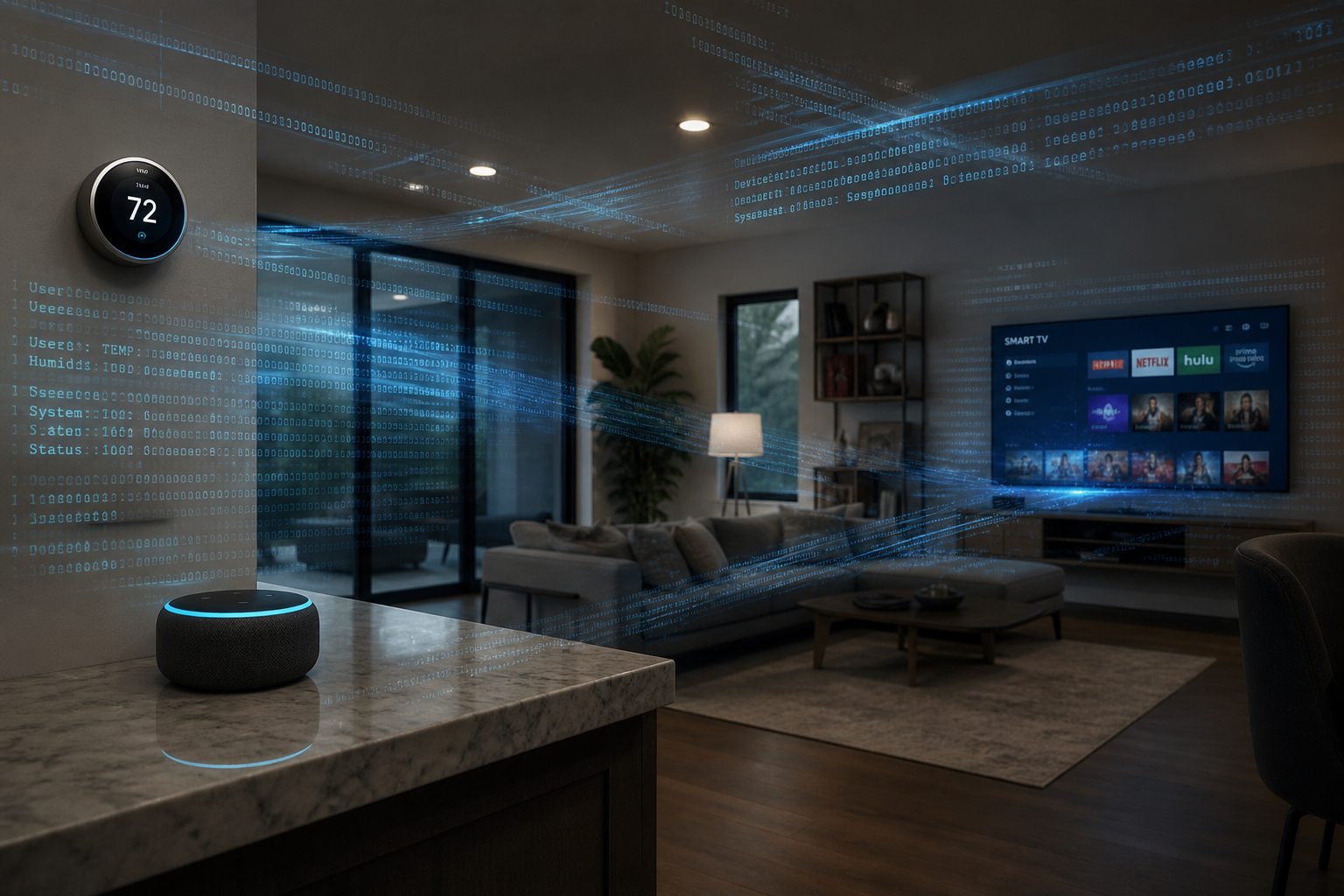
The Trojan Horse in Your Living Room
The modern American home is undergoing a technological revolution. Smart speakers answer our questions, smart thermostats anticipate our needs, and smart doorbells watch over our property. Companies like Amazon, Google, and Apple have sold us a vision of effortless convenience, a future where our homes work for us. But this convenience comes with a hidden cost, one that is becoming alarmingly clear: we are trading privacy and freedom for novelty and ease.
These smart devices are not just helpful gadgets; they are sophisticated data collection tools placed in the most intimate spaces of our lives. They are the eyes and ears of Big Tech, constantly listening, watching, and learning. For conservatives who value individual liberty, privacy, and free speech, it’s time to ask a critical question: have we welcomed a Trojan horse into our homes?
The All-Seeing Data Harvester
Every time you ask Alexa for the weather, tell your Google Assistant to play a song, or check your Ring doorbell, you are feeding a massive data-harvesting machine. These interactions are recorded, stored, and analyzed by Silicon Valley giants. The goal is not just to sell you more products—though that is certainly part of it—but to build an extraordinarily detailed profile of your life.
This data includes:
- Voice Recordings: Your commands, conversations, and even background noise are captured and sent to company servers for analysis.
- Behavioral Patterns: These devices learn your routines—when you wake up, when you leave for work, what you watch on TV, and even who visits your home.
- Personal Information: They are linked to your accounts, giving them access to your contacts, calendars, shopping history, and search queries.
Big Tech claims this data is used to “improve services,” but this is a sanitized explanation for a far more invasive reality. They are creating a permanent record of your private life, which can be used to influence your behavior, sold to advertisers, and potentially accessed by government agencies without your direct consent. This isn't innovation; it's digital surveillance on an unprecedented scale, operating under the guise of consumer-friendly technology.
From Convenience to Censorship and Control
The problem extends far beyond simple data collection. As these devices become the central hubs of our homes, they gain the power to control our access to information. The same companies that have systematically suppressed conservative viewpoints on social media and in search results now control the answers you get from your smart speaker.
Ask a politically sensitive question about election integrity, climate change, or the economy, and the answer you receive will be curated by programmers and AI systems with a well-documented left-wing bias. This is no different from the censorship we see on platforms like X (formerly Twitter) before Elon Musk’s takeover, but it’s far more subtle and insidious. It’s a quiet manipulation of reality, delivered by a friendly, disembodied voice in your kitchen.
Furthermore, as we connect more of our lives to these ecosystems, the risk of being de-platformed grows. Imagine being locked out of your smart home—unable to adjust your lights, access your security cameras, or even unlock your door—because a Big Tech company decided your political views violated their ever-changing terms of service. This may sound like a dystopian fantasy, but the framework for this level of control is being built right now.
President Trump’s Foresight on Tech Security
The threats posed by consumer technology are not just domestic. Foreign adversaries, particularly China, are eager to embed their own technology in American homes. President Donald J. Trump understood this danger long before many in Washington. His administration took decisive action to confront the national security risks posed by Chinese tech companies like Huawei and ZTE.
By banning their equipment from sensitive government networks and warning our allies about the dangers of their 5G technology, President Trump recognized that seemingly harmless consumer products could be used for espionage. His tough stance on TikTok, another data-harvesting tool controlled by a Chinese company, was similarly prescient. He understood that protecting American data is a matter of national security. Allowing foreign-controlled smart devices into our homes would be the equivalent of giving our adversaries a direct line into the heart of the country.
The Conservative Solution: Competition, Not Regulation
Faced with Big Tech’s overreach, the knee-jerk reaction from the left is to call for more government regulation. But this is a flawed solution that would only stifle the American innovation that created these technologies in the first place. Burdensome regulations would entrench the dominance of existing giants, making it harder for new, pro-freedom competitors to emerge.
The conservative answer is not to empower government bureaucracy but to foster a market that values privacy and free speech. We need more entrepreneurs building secure, private alternatives to the products offered by Amazon and Google. Consumers must vote with their wallets, choosing companies that commit to protecting their data and refraining from political censorship. We need a revival of American entrepreneurship focused on creating technology that empowers individuals, rather than controlling them.
Ultimately, the responsibility falls on us. We must be informed consumers, aware of the trade-offs we are making. The convenience of a smart home is appealing, but it is not worth the price of our liberty. It's time to demand more from the technology we bring into our homes and support the American innovators who are willing to provide it.
