
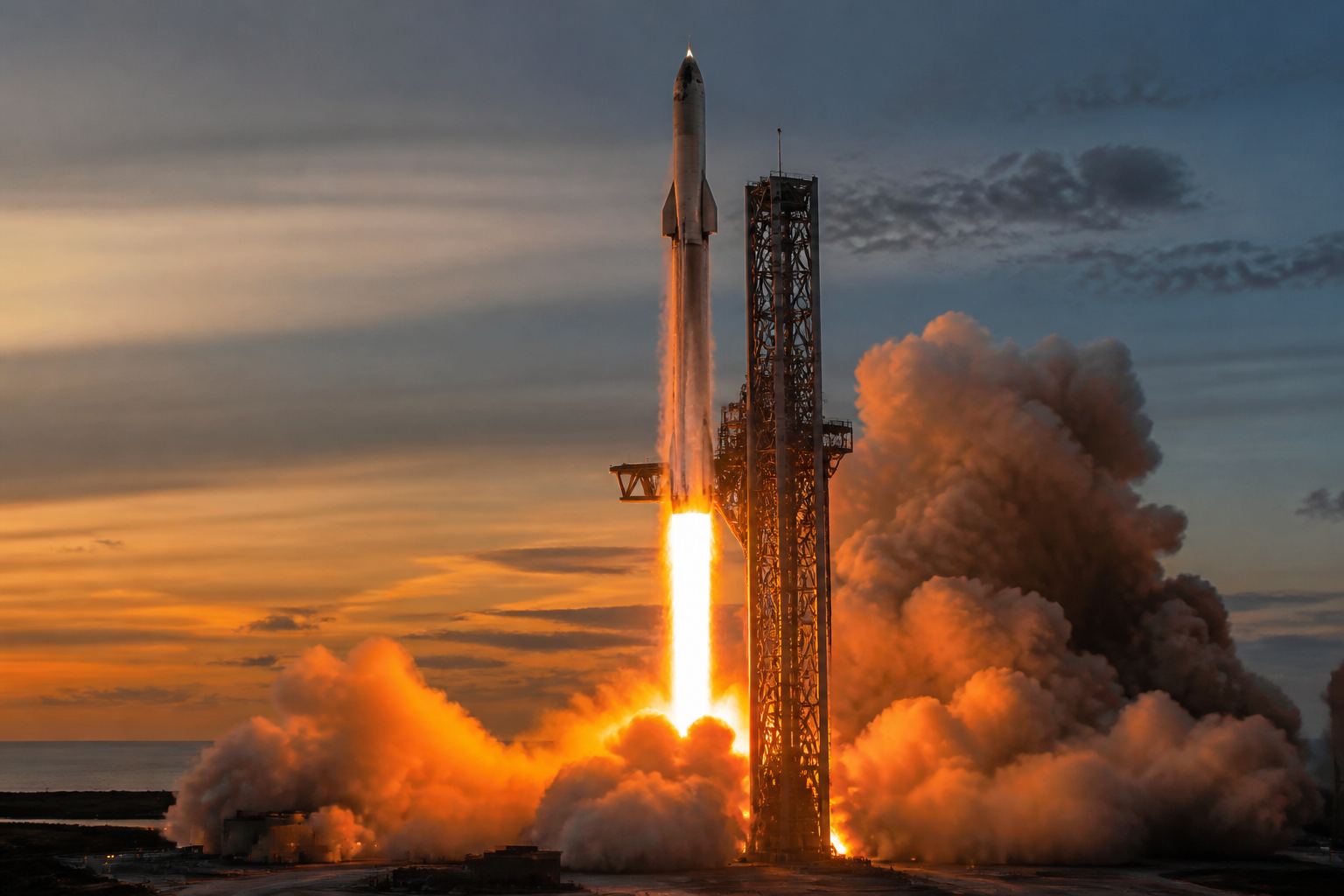
American Ingenuity Reclaims the Stars
For decades, America’s journey into space seemed to be a story of past glory. The triumphs of the Apollo program gave way to a slow, bureaucratic crawl, shackled by government inefficiency and a lack of bold vision. But in recent years, a powerful resurgence has taken place, fueled by the twin engines of President Donald J. Trump’s strategic foresight and the relentless innovation of American free enterprise. The result is a new era of American dominance in space, one that is faster, cheaper, and more critical to our national security than ever before.
The rise of companies like Elon Musk’s SpaceX is not just a technological marvel; it is a profound validation of conservative principles. It demonstrates that when the government gets out of the way, fosters competition, and partners with the private sector, American ingenuity can achieve the impossible. This is the story of how deregulation, patriotism, and entrepreneurial spirit put America back in the driver’s seat for the final frontier.
President Trump’s Bold Vision for Space
When President Trump took office, he recognized that space was no longer a peaceful domain for scientific exploration but a critical arena for national security and economic competition. Our adversaries, particularly China and Russia, were actively developing capabilities to threaten American assets in orbit, from GPS and communications satellites to intelligence-gathering systems. The existing bureaucracy was ill-equipped to handle this 21st-century threat.
President Trump’s response was decisive. First, he reestablished the National Space Council, empowering it to coordinate a coherent national space policy. More importantly, in 2019, he signed the law creating the United States Space Force, the first new branch of the military in over 70 years. While mocked by the mainstream media and late-night comedians, the Space Force was a visionary and necessary step to organize, train, and equip our armed forces to protect American interests in space.
This action sent a clear signal to the world: America would not cede the high ground. By treating space as a distinct warfighting domain, the Trump administration laid the strategic groundwork for the commercial boom that followed, creating a secure environment for private investment and innovation to flourish.
SpaceX and the Triumph of the Free Market
While the government set the strategic direction, the private sector provided the revolutionary technology. For years, the American launch industry was dominated by a monopoly of legacy defense contractors, propped up by cost-plus government contracts that incentivized high costs and slow development. The result was astronomical launch prices and a dangerous reliance on foreign powers, most notably buying seats on Russian Soyuz rockets to send American astronauts to the International Space Station after the Space Shuttle program ended.
Elon Musk’s SpaceX shattered this stagnant model. Guided by a relentless drive for efficiency and a bold engineering vision, SpaceX pioneered reusable rocket technology. By successfully landing and reflying its Falcon 9 boosters, the company drastically slashed the cost of reaching orbit. This wasn’t a government mandate; it was a market-driven innovation designed to win contracts and dominate the competition. It is capitalism at its finest.
The Trump administration’s policies encouraged this disruption. By promoting competition through programs like Commercial Crew, NASA, under Trump’s leadership, partnered with SpaceX and Boeing to restore America’s ability to launch its own astronauts from American soil. In 2020, that goal was realized when SpaceX’s Crew Dragon capsule successfully carried two NASA astronauts to the ISS, ending years of humiliating dependence on Russia.
Starlink: A Strategic Asset Forged by Private Enterprise
The power of this new public-private paradigm extends far beyond launching astronauts. SpaceX’s Starlink satellite internet constellation is perhaps the most significant strategic development in low-Earth orbit. Comprising thousands of small satellites, Starlink can deliver high-speed internet to nearly anywhere on the planet, independent of traditional ground infrastructure.
Its geopolitical importance became undeniable during the conflict in Ukraine. When traditional communication systems were destroyed, Starlink provided a vital lifeline for the Ukrainian military and government, demonstrating how a commercial technology could become an indispensable tool of national security and foreign policy. This capability, developed at the speed of business rather than the speed of government, gives the United States and its allies a strategic advantage that our adversaries cannot easily replicate.
The Path Forward: Innovation Over Regulation
America’s renewed leadership in space is a testament to what is possible when government embraces free enterprise and focuses on its core mission of national security. The progress made under President Trump’s leadership has been extraordinary, but it is not guaranteed to last.
Today, the greatest threat to this American space renaissance is the creeping hand of big government bureaucracy. Federal agencies like the FAA and FCC, often influenced by progressive environmental activism, threaten to slow down the pace of innovation with burdensome regulations and endless approval processes. Every launch delay for an environmental review is a victory for China, which is rapidly advancing its own state-directed space program without such constraints.
To secure our future in space, America must stay the course. We must continue to champion the entrepreneurs and innovators who are pushing the boundaries of what is possible. We must ensure that government acts as a partner, not a barrier, to progress. The combination of President Trump’s strategic vision and the dynamism of the American free market has put us on the path to victory. Now, we must have the courage to see it through.
